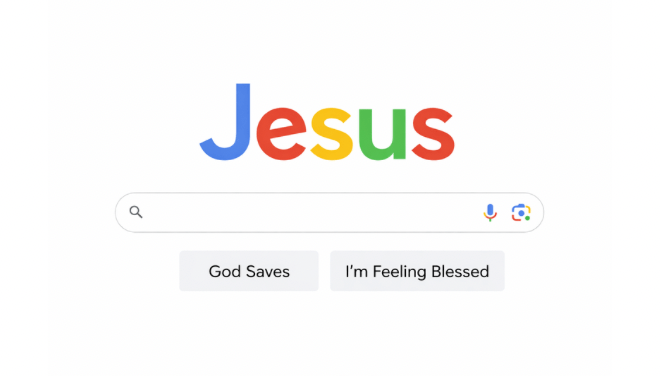
Google. Just the word. What is it? A search engine for the vastness of the world wide web. Google. No explanation required. You hear it and immediately know what it does, what it’s for, and how you might use it. That didn’t happen by accident. The name comes from googolplex—a number…like million, billion, thrillion…but a googolplex is a number so large it stretches past our ability to picture it. Not just “a lot,” but something beyond counting, beyond writing down, beyond holding in the mind. The name gestures toward vastness itself.
Over time, the name Google proved itself. It consistently opened access to something immense—information, knowledge, connection. And because it did, the name stopped functioning merely as a label and became a verb. We don’t describe the action anymore. We just say the name, and everyone knows what is happening. Even the logo reinforces the point: no image, no symbol, no explanation—just the name. The name alone carries the meaning.
That’s what happens when a name aligns perfectly with what it actually does. It no longer advertises. It testifies. It opens something vast simply by being spoken.
The church dares to say that the name “Jesus” works like this—not because it is familiar, and certainly not because it is overused, but because the life behind it has proven faithful. The Holy Name of Jesus opens something vast, something whose implications continue to unfold far beyond what anyone could calculate.
Most names, especially branded names, point forward. They promise. They suggest improvement or possibility: this could help you; this might make life better. In the ancient world, names often did something similar, but with sharper edges. Names carried meaning, lineage, destiny. They located a person within a story larger than themselves. To name a child was to speak hope—and sometimes fear—about the future.
The name “Jesus” enters that world and quietly overturns expectations. It does not elevate status or secure legacy. It does not invoke power or prestige. It declares purpose. In St. Matthew’s gospel from today, the angel says to Joseph, “You shall name him Jesus, for he will save his people from their sins.” That sentence matters more than we often allow. It does not say, “He will inspire people,” or “He will teach people,” or even “He will show people the way.” It says, “He will save.”
And it does not speak in general terms. His people. Real people. Actual lives. God saves—not as a concept debated by scholars, not as a theory argued in the abstract, but as a personal act directed toward those who need saving. In a world accustomed to names that asserted dominance or divine favor, this name announces rescue.
God saves people who are bound by sin, fear, regret, and the accumulated weight of what cannot simply be undone. God saves not someday, not hypothetically, but for us. For you.
And yet, even here, the scale is already immense. A single child is given a name that declares God’s saving action for real people, and the implications of that action reach far beyond what anyone standing there could imagine. What begins personally does not remain small. One name opens something vast.
St. Paul tells the Philippians and us today how that vastness actually unfolds. Not through domination. Not through spectacle. Through faithfulness lived all the way through. Jesus does not save from a distance. He enters fully into human life. He empties himself. He takes on vulnerability. He becomes obedient, even to the point of death.
If you pause long enough to notice, that is a startling pattern. Influence usually expands through accumulation—more power, more visibility, more control. Here, the expansion happens through release. Through self-giving. Through a willingness to go lower rather than higher. And yet, from that downward movement, something extraordinary emerges.
One life lived in humility creates consequences that radiate outward across time. One act of love alters trajectories that cannot be mapped in advance. The effects multiply quietly, almost invisibly, like ripples moving outward from a single point long after the initial moment has passed. The reach of that life becomes greater than any single place or generation could contain.
That is why the name is exalted. Not because it asserts itself over others, but because it has demonstrated a gravity all its own. The name carries weight because the life behind it never contradicts it. Every action aligns with its meaning. God saves. God saves his people. God saves…us. God saves…you. And the implications of that saving action continue to expand beyond our ability to measure them.
In his eighth psalm, the psalmist invites us to stand still and feel the strangeness of it all. Human beings are small. Our lives flicker briefly against the long arc of time. Our names are easily forgotten. And yet God chooses to place something immeasurably large into the care of a single human life.
Not a title carved into stone. Not a slogan meant to impress. A name spoken softly, carried gently, shared among ordinary people. A life that eats, sleeps, works, weeps. The kind of life that could easily be overlooked.
And this is where the wonder deepens. God does not seem troubled by the fragility of the vessel. God entrusts infinite purpose to finite flesh. Grace beyond counting is held within a body that can suffer and die. What looks small becomes the doorway to something vast.
This is how God moves—patiently, quietly, faithfully. Small beginnings. Ordinary moments. A reach that extends far beyond what the moment itself suggests. The vastness of God’s mercy does not arrive all at once. It unfolds.
In baptism, this vast and faithful name comes very close to us. It is spoken over you—not as an idea, not as a label, but as a gift. You are named. You are claimed. You are included. And then something simple happens: a mark is made.
The sign of the cross is traced, often so lightly it could almost be missed. And yet it stays. Not on the skin in a way others can see, but on the life itself. In the language of branding, it is a mark of belonging. Like a logo that points beyond itself, the cross doesn’t explain everything. It doesn’t need to. It quietly carries the weight of the name it represents. It reminds without words. It says, “You belong here. This life is part of this story.”
We live surrounded by brands like that—names with marks and symbols that don’t need captions because they point back to a story we already recognize. In baptism, God gives us something similar—but deeper. This is not branding for image or performance. It is branding as belonging. The cross is not about visibility or reputation; it is a mark that stays with you, reminding you whose life you are part of even when nothing is said aloud.
This is where the difference shows up in daily life. You are not asked to be the brand or to carry its meaning by effort or display. You are branded by grace. You are marked by a name that already knows what it is doing. When life feels scattered or small, the mark says the name still holds you. When you feel unsure of your place, the brand quietly points back to the one to whom you belong.
Baptism doesn’t make life louder or more impressive. It makes life steadier. It places even the ordinary moments—work, relationships, choices, care for others—within a story that is patient and faithful. The mark doesn’t shout. It stays. And in staying, it keeps pointing you back to the name that saves.
Once we bear that name, our lives begin to take on a different shape. Not suddenly. Not perfectly. But truthfully. Because bearing the name of Jesus means we no longer live only for ourselves. We live in a way that reflects what the name means.
This is where vocation becomes concrete. Acts that seem small are no longer small. Choosing mercy instead of retaliation. Choosing honesty instead of convenience. Choosing faithfulness when it would be easier to disengage. These moments may feel ordinary, even unnoticed, but they are never isolated.
When a life bears this name, its actions participate in something larger than the moment itself. A kind word spoken at the right time. A boundary held with grace. A refusal to reduce another person to an enemy. These things ripple outward. They shape communities. They influence lives we may never meet. They become part of God’s ongoing saving work in ways we cannot track or measure.
We are not asked to calculate the reach of our faithfulness. We are asked to live it. The implications will take care of themselves. Names endure when they are worthy of trust. This one endures because it has already kept its promise. The cross itself speaks the name “Jesus” without explanation, because the story behind it is complete.
And in baptism, that story now includes us—a story a number so large it stretches past our ability to picture it, yet intimate everything about us sometimes even better than we know ourselves. We are bound to a name whose reach cannot be numbered, whose implications exceed imagination, whose grace continues to unfold through ordinary lives lived in faithfulness—a googolplex of grace, grace beyond counting, beyond writing down, beyond holding in the mind, unfolding one faithful life at a time.
 The Rev'd Daniel W. Spigelmyer, Jr.