Many of you know I like to head down to Nashua pretty frequently. I take Route 13 through Brookline to Amherst and then hang a right onto 101A. It’s a drive I really enjoy: the forests, especially with the leaves a few weeks back peeking, and the ponds. They shimmer between the trees, and I always tell myself I’ll paint a landscape of this pond or that pond someday.
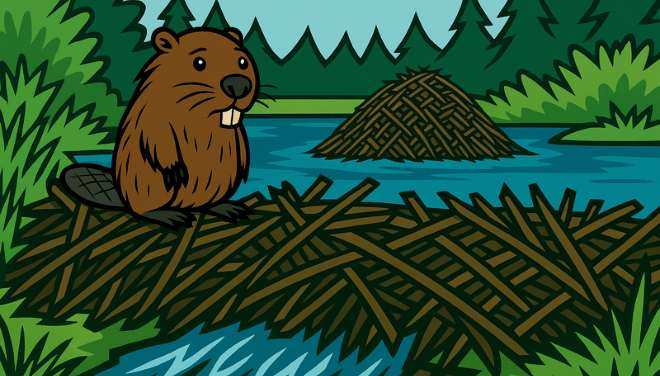
There’s one pond I always notice—just before you get to Lull Farm as you’re heading toward Nashua. You can’t miss it, because every time I go by, it looks a little different. It’s actually not even on the map as a pond, because it’s not a pond. It’s a stream, but the water’s so high it’s flooded into an effective pond. And it’s filled with trees and, here and there, what looks like big piles of wood in the middle of the water.
The reason?
Beavers.
Now, beavers are fascinating creatures. They’re one of nature’s great engineers—determined little architects who can reshape an entire landscape with nothing more than their teeth and patience. They can weigh up to sixty pounds, swim like Olympians, and use those flat tails as paddles, rudders, and warning signals. Their teeth are orange because they’re strengthened with iron, and they never stop growing, so they have to keep chewing just to stay in good shape.
They fell trees mostly at night, dragging branches through the water to build dams and lodges that are works of art—strong enough to survive a winter, clever enough to give them underwater doorways so no predator can follow. Families live together there, parents, kits, even last year’s young, all pitching in to repair the walls and haul new branches. They’re the original homebuilders, and they never seem to take a day off.
Of course, not everyone is thrilled to have beavers as neighbors. Dennis, I know you’ve got a few opinions about the ones behind your house. They’ve flooded his creek more than once, and I suspect he’s not the only one who’s found a freshly dammed ditch where there used to be a trickle. Beavers are persistent—sometimes to a fault. But that persistence, that relentless drive to build and rebuild, is exactly what makes them so remarkable.
Beavers have been shaping the world this way for millions of years. Long before there were people here, there were beavers redirecting streams and carving out wetlands. When they build a dam, they don’t just make a pond—they make a neighborhood. Frogs, fish, birds, turtles, insects, even thirsty deer all benefit from the ponds they create. Their work turns dry places into wetlands, filters the water, and stores it for drought.
It’s easy to see them as destructive, but in truth, they’re creative beyond measure. What looks like a mess—mud and sticks piled across a stream—is actually an act of renewal. Beavers remind us that sometimes you have to disturb things to bring new life. You have to make a little holy chaos before creation can sing again.
You’ve got to be thinking—why is he talking about beavers? Fair question. But the more I thought about them, the more I realized they might just be a sermon waiting to happen. Because beavers are a perfect image of what faith looks like in a world that’s always shifting. They don’t panic when the water rises—they build. They don’t give up when the current changes—they adapt. They don’t stop working when their dams wash out—they start again. And maybe that’s exactly the kind of faithful living God calls us to.
So today’s message is this: the Gospel invites us to be busy beavers—finding holiness in ordinary work, healing in creation, and hope in the very moments that unsettle us.
At first glance, the beaver’s pond looks like chaos. Water spilling over, trees gnawed down, branches scattered in every direction. But if you stand still long enough, you begin to see order inside the disorder—how every branch, every ripple, every pool of water is part of something far more intricate than it appears. What looks like destruction is creation reorganizing itself. The beavers aren’t wrecking the stream, they’re reshaping life.
That’s the hidden logic of the world God made—the strange, elegant way the Spirit keeps bringing structure out of chaos. The same current that erodes a riverbank also carves its path. The same fallen branches that look like waste become the foundation of a new ecosystem.
Creation has always worked that way: forming, reforming, transforming. The prophets saw it as fire that refines but doesn’t destroy. The psalmist heard it as waters clapping their hands for joy. Jesus called it endurance—the strength to trust that even when the temple crumbles, God is not finished. Paul lived it in his own body, working day and night so others might see that faith isn’t theory but steady labor. Each of them glimpsed the same truth: God’s renewal begins exactly where things fall apart.
Beavers don’t panic when the water rises. They build. They adapt. They use what’s fallen to make what will shelter. Their work turns loss into life, chaos into renewal. That’s the shape of holy endurance. Not human grit or busy striving, but the creative persistence of God alive in us.
Jesus said, “By your endurance you will gain your souls.” Paul lived those words, but neither believed we can conjure that endurance on our own. The endurance itself is a gift—the Spirit’s own power working within us. The same Spirit who inspired the prophets and raised Christ from the tomb fortifies us when our dams give way. Endurance is grace at work. The same Spirit who renews creation renews us, until we find ourselves building again beside the waters of God’s mercy.
And this matters, because most of us know what it feels like to be flooded. Life moves fast and our calendars overflow. We’re busy—so busy that sometimes our work, even good work, begins to drain the life out of us. What God designed as purposeful activity can be twisted into exhaustion. Overwhelming busyness is the devil coopting God’s plan for us. God means for us to be doing things, enjoying and contributing to life, but when busyness becomes an arduous chore, it’s Satan taking God’s design and warping it, the oppressor oppressing us. Satan likes nothing more than to see us suffer.
But the Spirit will not leave us there. When we feel flooded by fear, the Spirit steadies us with courage. When we’re weary of rebuilding, the Spirit gives us holy persistence. When our faith feels splintered, the Spirit binds us together in community. When the current is too strong, the Spirit becomes the stillness beneath the surface. And when all we can do is float, the Spirit keeps us buoyant until we can build again.
This is not the endurance of stoics or the toughness of the proud. It’s the endurance of builders—the kind that trusts the water will settle and the wood will hold. It’s the rhythm of the beaver, working with the current instead of against it. It’s the faith of Christ alive in us through the Spirit—patient, steady, creative.
God does not ask us to invent strength we don’t have. God gives it as a gift. The Spirit takes our tired efforts, our splintered branches, and shapes them into something strong enough to shelter life. The holy life isn’t escape from the flood. It’s learning to build in the middle of it.
That pond by Lull Farm comes to mind again—the one that isn’t supposed to be there, not even on the map. It began as a trickle, and now it’s a quiet basin alive with birds and cattails. What we thought was ruin turned out to be renewal. What looked like trouble became the condition for new life.
That’s what the Spirit does. The Spirit works with what is, not what was. You and I live in a world that keeps changing course, flooding over our careful plans. The Spirit doesn’t stop the water. The Spirit helps us build in it. God calls us to the same kind of holy busyness as those beavers—not frantic, not exhausted, but purposeful, joyful, creative. There’s a difference between the work that drains and the work that delights. The first enslaves. The second participates in grace.
When you show up to care for someone who’s grieving, you’re building the dam again. When you take time to teach, serve, fix, listen, or forgive, you’re part of God’s quiet restoration. Every small act of mending, every patient word, every moment of courage in the flood becomes part of the divine architecture of grace.
“By your endurance,” Jesus said, “you will gain your souls.” And by that, he meant the Spirit’s endurance in you—the Spirit’s building through you.
Picture the pond one more time. The flooded trees, the slow ripples, the light glinting across the surface. What once looked ruined now hums with life. What seemed chaotic has become calm. The sound of running water has turned into music.
That’s the world God keeps remaking through Christ—the same creative rhythm that holds galaxies together and stirs the smallest heart to hope. The same Spirit that guided the prophets and apostles is guiding us still, turning our ruins into refuges, our failures into foundations.
So don’t lose heart when the waters rise. Don’t believe the lie that you have to hold it all together on your own. The Spirit is already holding you. The God who made you is still building you.
God calls us to be busy beavers—steady in love, creative in faith, unafraid to rebuild, because the Spirit never stops building in us.
 The Rev'd Daniel W. Spigelmyer, Jr.