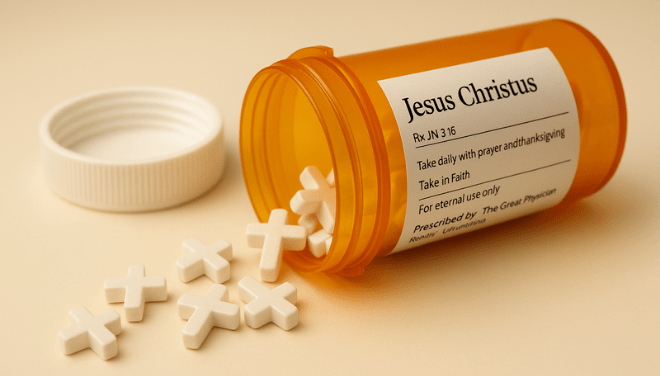
Picture a pill bottle rattling in your hand.
Tiny capsules, each packed with power.
Penicillin that saves a child from infection.
Insulin that steadies a diabetic’s life.
A little white tablet that can tame pain, or lift the shadow of depression. It’s astonishing when you think about it: chemistry, molecules, the very building blocks of creation re-arranged to heal. In the same way scientists marvel at the origins of the universe, we marvel at what medicine can do. It feels like magic, but it’s God’s own handiwork refracted through human skill.
Yes—better living through pharmaceuticals.
The word “pharmaceutical” comes from the Greek “pharmakon”—a word that means both “medicine” and “poison.” That paradox is right at the heart of our lives. The same substance that heals in the right dose can destroy in the wrong one. Every prescription is a balance between life and death, between what saves and what harms.
And scripture knows that tension. Sirach the sage insists medicine is a gift from God: “The Lord created medicines from the earth, and the sensible will not despise them.” The psalmist pushes deeper: “He heals the brokenhearted, binding up their wounds, and he calls the stars by name.” Medicine may bind wounds, but God doesn’t just patch us up—he knows us as deeply as he knows the constellations.
Then Jesus stands in Nazareth and makes the boldest claim of all: “Today this scripture is fulfilled in your hearing.” What scripture? Good news to the poor. Release to the captives. Recovery of sight to the blind. Freedom for the oppressed. The year of the Lord’s favor. As foretold by the prophet Isaiah. Healing is no longer scattered across remedies and rituals—it’s embodied in him. And Paul reminds Timothy: endure suffering, keep the faith…but also bring my cloak and the books. The balance again—eternal calling and earthly need. That’s the tension of “pharmakon” itself, and it’s the tension of life in God’s hands.
And it’s fitting that we remember St. Luke today—the beloved physician, a Greek by birth, an evangelist by grace. It makes perfect sense that a doctor’s gospel would overflow with stories of healing—of lepers cleansed, the blind seeing, the lame walking, and the broken restored to community. In Luke’s world, medicine was the study of balance and harmony: the art of aligning the body with the forces that sustain life. In the Jewish world of Jesus, healing was the touch of divine mercy, the visible compassion of God breaking into human pain. Luke carried both understandings into his witness. He knew that true health is not just freedom from illness but reconciliation—body and soul made whole in Christ. The careful physician became the careful storyteller and chronicled the work of the Great Physician who heals the world.
But let’s be clear. Medicine, as good as it is, cannot define life. We call this vision a theology of life—life as God gives it: abundant, holy, bound up with love. And because it’s God’s gift, we as Christians must speak forcefully into the world about what it means. Life in the womb is precious. But so is life outside the womb—the poor, the hungry, the forgotten. Sanctity of life means nothing if it isn’t joined to the dignity of death, if we abandon people in their final hours or insist because their bodies still can perform basic functions, even with the aid of machinery, they cannot choose their own death because despite the quality of living having diminished to the point each moment feels like a living hell. Empathy and compassion must be deepened by responsibility and obedience; otherwise they collapse into sentiment or cruelty. And then there is war. We name its evil, yes, but we confess too that there are times when the defense of the innocent demands it. Even then, our duty isn’t erased but sharpened—to see and care for the innocents on every side, even as we wage what feels necessary. A theology of life is a bold witness: life is always more than survival. And yet—a theology of life demands we consider every circumstance and not demand simple blanket answers. A theology of life embraces the complexity, indeed, the messiness of living—and values it in totality.
And here’s where it leads us. If life is always more than survival, then the sacraments are the antidote to pharmaceuticals’ double edge—their promised cure and hidden poison. Every medicine of this world carries its risk. Every pill has a warning label. Every cure is partial. But the sacraments are different. They are the healing arts of the Great Physician, of Jesus our Lord. In them the measure is always dosage, and the remedy never fails.
For when the time was fulfilled, God set him forth as the reconciliation of our division—both with one another and with God. As the serpent in the wilderness, once a scourge, became a sign of healing, so Christ upon the cross became the mending of the breach. And yet he laid upon us also the call to endure, that healing might be made complete.
In baptism, Christ drowns despair and raises hope. No side effects. No risk of overdose. A cleansing deeper than any prescription, a treatment that doesn’t just extend life but recreates it.
At the table, Christ sets a feast. Bread becomes his body, wine his blood—the medicine of immortality, with no warning label attached. Here no one is excluded, no insurance card required. Here the remedy does not fade, and the hunger is truly satisfied.
In absolution, the cross traced over our weakness is not symbolic. It is Christ himself binding wounds invisible to charts or scans. It is the healing touch of the physician who still makes house calls to the sick of heart.
The sacraments are God’s final word over the double edge of every earthly cure. Here the remedy is given without risk, without limit, without end.
So yes—better living through pharmaceuticals. Give thanks for penicillin, for insulin, for every doctor and nurse whose hands bear God’s healing touch. But better living through Jesus? That’s the heart of it. In him, the poor hear good news. The blind receive their sight. The oppressed go free. In him, death is not the end, but the doorway into life abundant. And so we press forward—not with fear, not with despair, but with courage and with wonder. For Jesus Christ is the medicine of immortality, the savior of the world, the healer of our every ill.
 The Rev'd Daniel W. Spigelmyer, Jr.