Have you ever noticed how in moments of desperation, people will try almost anything? I mean, remember COVID? We didn’t know what would work. People were spraying bleach on their groceries, standing six feet apart like lonely statues in a graveyard. I remember at the outset, getting in touch with Marcia to ask if a pizza I had delivered from Domino’s was safe to bring in immediately. I think we decided that after ten minutes outside on the porch it was fine to bring in—no need to spray the box with sanitizer.
But it got crazier yet. This is the part that sounds like it came from some twisted apothecary’s tale—then someone decided that a horse dewormer might be the key to salvation. Ivermectin. The pill you give livestock to chase writhing worms out of their guts. It became the miracle hope. People lined up, swallowing it in faith.
And yet, nothing. Against COVID it was powerless. A cruel joke. You could eat a bucket of ivermectin, and the virus would just grin like a phantom in the night.
But here’s the unexpected turn: years later, scientists are discovering it does have surprising power beyond deworming horses. Not against COVID, but against one of the oldest plagues of humankind—malaria. A poison for the parasites that ride in mosquitoes’ blood. A cure where no one expected it. A medicine mocked in one moment, suddenly proving itself in another.
Unexpected medicine.
Foolish medicine.
The kind of thing that makes you wonder if the line between hope and madness is razor thin. Sometimes, oftentimes it is…
Sin is like a parasite. Let me rephrase: sins is a parasite. Not a scratch you can bandage. Not a cold you can wait out. A parasite—it attaches, it feeds, it spreads, it weakens, it never lets go. And like malaria, it runs in the bloodstream of humanity, passed down from one generation to the next.
The ancient stories describe it in detail. People forget God, they wander, they rebel. Then they cry out, God forgives, and they forget again. It’s a cycle, like malaria flare-ups—fever and chills, relief and relapse. Their faith is shallow, lips moving while their hearts turn elsewhere.
And then the sickness shows itself in public. Look at today’s first reading…The Hebrews grumble, and snakes appear, fangs flashing, venom burning in their veins. The hidden parasite made visible. The cure? Not killing all the snakes. Not handing out antivenom. Instead, God tells Moses to lift up a bronze serpent, the very image of the thing that kills them. Whoever looks at it lives.
It makes no sense. Looking at a statue doesn’t heal snakebite. And yet it works, because God says it will. That’s how sin is handled: not by avoidance, not by sheer willpower, but by turning eyes toward the cure God provides. Looking, trusting, believing.
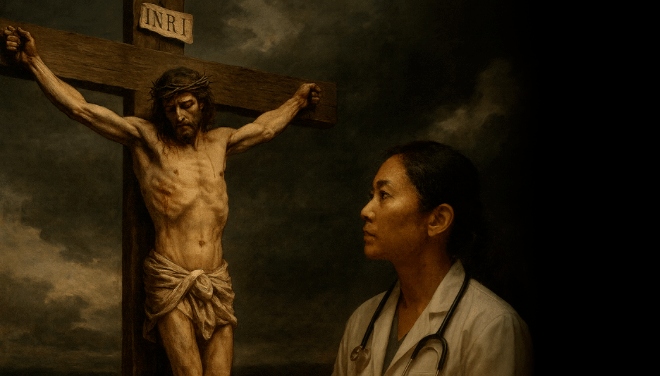
Jesus knew the story. That’s why he says, “As Moses lifted up the serpent in the wilderness, so must the Son of Man be lifted up.” His cross is the cure. He is the unexpected medicine.
And St. Paul writes of it in our second lesson today, quoting one of the oldest hymns of Christianity: though Christ was equal with God, he did not cling to power. He emptied himself, took the form of a servant, humbled himself even to death—death on a cross. That’s the hinge. Death itself, but not just any death—the shameful death of a criminal, outside the city walls, nailed to rough wood. And because of that obedience, God exalted him, gave him the name above every name. It doesn’t look like medicine. It looks like execution. But the cross is God’s appointed cure for the parasite of sin.
It’s crazy when you think about it. A wooden cross soaked in blood as the hope of the world. Nails and thorns as instruments of healing. A dying man as Savior. Nothing about it makes sense.
But we’ve known it’s crazy since the very beginning. Paul, again, in his letter to the Corinthians admits it: “The message of the cross is foolishness to those who are perishing, but to us who are being saved it is the power of God…for God’s foolishness is wiser than human wisdom, and God’s weakness is stronger than human strength.”
And yet, unlike ivermectin for COVID, the foolishness of the cross works. It doesn’t treat symptoms. It cures the root disease: sin itself. The parasite is stripped of power, death is declawed, the devil is undone. And here’s the kicker: the cure keeps being applied, maybe think of it as a booster, if you will. Not as pills or injections, but in promises.
Baptism—water poured on a head. Foolishness. Just water. Yet in God’s foolishness, it drowns sin and raises to new life.
Communion—bread and wine. Foolishness. Just food. Yet in God’s foolishness, it is body and blood, medicine of immortality, Christ himself given and shed for you.
The sacraments carry the same strange character as the cross: what looks weak, ordinary, foolish is God’s wisdom, God’s power, God’s cure. How many people scoff at Christians, at us for baptism? For communion? It’s just water…It’s cannibalism. Foolishness to the popular wisdom but our lived, breathed, experienced power of God to bring salvation, wholeness, healing in our lives and the lives of those who embrace God’s promise…
God forgives even when our faith is shallow, even when our lips move and our hearts wander elsewhere. God restrains anger when rebellion burns hot. God hears the cry of those with poison coursing through their veins and makes a way of healing where none seems possible.
But the cross, but Jesus—he takes the ordinary and floods it with glory. A birth in a manger, no palace. A healer touching lepers with bare hands. A rabbi who eats with tax collectors and sinners. A Savior hanging on wood, mocked with a crown of thorns. A corpse placed in a borrowed tomb. And then—an empty grave at sunrise. A scarred body, breathing peace. A Lord ascending not to leave, but to fill all things and take the memory of his subjects with him.
None of it looks like wisdom. None of it looks like power. And yet it is God’s way of undoing what we call reasonable, overturning what we call wise. With God all things are possible—even undoing sound human reason with divine craziness.
Here’s the truth: parasites evolve. Diseases come back. Medicines fail. Even ivermectin, promising as it may be against malaria, won’t solve everything. But the medicine of the cross never fails. The parasite of sin adapts, to be sure—but it cannot mutate to escape the treatment of the cross. Death cannot find resistance. The devil cannot build immunity.
The cross is foolishness, yes. Foolishness that saves. Weakness that conquers. Unexpected medicine that heals the world. Lift your eyes to it, and you will see: not an accident, not an experiment, not a last-ditch gamble. The cross is God’s eternal cure. It is the power of relationship with God, the bridge between perishing and eternal life.
And so we proclaim: the cross stands while the world churns. The cross endures while humanity’s plans fall. The cross heals while sin afflicts. The cross lives while death dies.
Unexpected medicine, foolish wisdom, eternal salvation.
 The Rev'd Daniel W. Spigelmyer, Jr.