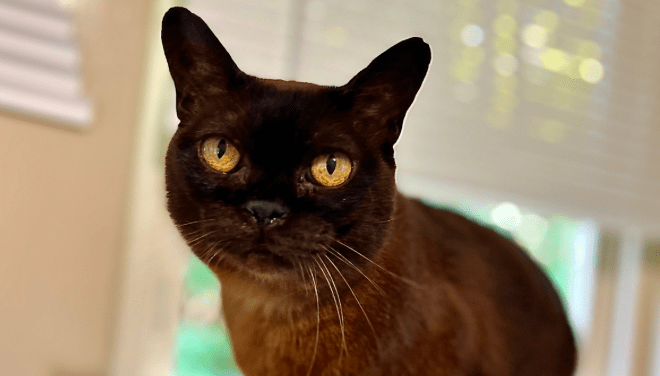
Let me tell you about Cedric.
Cedric is a cat, my cat—a Burmese—and a menace.
A lovable menace.
But a menace, nonetheless.
He climbs on my head while I’m sleeping. He raids the trash. He tries to steal food off my plate. He knocks things over just to watch them fall. He bullies Simon and Arthur, the other cats. He bullies Gracie. He stakes his claim in any chair I try to sit in.
He is small, relentless, stubborn—and deeply, absolutely mine. But I didn’t plan to adopt him. In fact, I had said—very clearly, very definitively—that I wasn’t going to take on any more cats. I already had two cats. That was enough. I was at capacity. Then my mom died.
Now, to understand Cedric, you need to understand my mom. My mom was—there’s no polite way to say it—an animalholic. She bred dogs. When she went into the hospital, she had several litters of chihuapoo puppies. There were oodles of cats. A rottweiler. A pair of coonhounds. A huge aquarium. And in one of the bedrooms, where most people might have had storage or old furniture, my mom had fourteen snakes—mostly boas and constrictors—housed in custom-built snake hutches that looked like fancy filing cabinets.
My mom loved baby animals. She loved raising them. But when they got older, her interest usually faded. They were still there, still fed, but the doting faded. Cedric was different. He wasn’t a kitten anymore, but she held onto him. There was something about him—she kept him close.
When she was hospitalized with COVID, she declined fast. Twenty-eight days. And before she was intubated, when my sister was able to speak with her and say goodbye, one of the last things my mother did—according to my sister—was to open her phone, look at a picture of Cedric, and stroke the screen while crying. That’s the last thing she did before being put on a ventilator. She never came off it.
So Cedric, this menace of a cat, came to me. When I finally got to him, he was in bad shape. His left eye was so infected I drove non-stop from Central PA to Dr. Sulin, who told me that if I’d waited even another day, he might have gone blind—or died. I babied him. I thought the other cats would bully him. But it turns out—he was the one who came in and took over. He adjusted. He survived. And now he’s very much at home. Cedric is a menace. A lovable menace. But he’s mine. I adopted him. I received him. And I love him. He was a mendicant menace, a menacing mendicant—saint and sinner alike.
And I have to wonder if God doesn’t say the same about me. God doesn’t wait for us to be manageable. He receives us as we are—messy, insistent, even menacing—and makes us family through grace. Saint and sinner alike…
Paul’s letter to Philemon tells the story of two men—Philemon, a well-off Christian who hosted worship in his home, and Onesimus, who had wronged Philemon and ended up with Paul in prison. Paul doesn’t say how Onesimus ended up there, but he calls him “my child” and “my own heart”—language of love and adoption. Paul asks Philemon to welcome Onesimus as he would welcome Paul himself.
To forgive him.
To treat him as a brother.
To receive him.
Menace and mendicant alike.
Saint and sinner alike.
There’s an ancient word for this kind of turning, this gospel-centered reorientation: metanoia. It’s often translated “repentance,” but it means more than that. It’s a full change of mind and heart. A re-seeing. A reversal. Metanoia says: I once saw you as a problem; now I see you as my brother. I once saw you as a liability; now I see you as my joy. I once saw you as someone to keep away from; now I see you as someone I must receive.
That’s what the gospel does to us.
The gospel reorients and refocuses our vision.
We don’t get to receive only the people we like. We receive the people God gives us. We receive the people God loves. We receive the Onesimuses of the world—those with a past, those we’d rather not deal with, those who cost us something. Because we were received. Christ died while we were still sinners. The gospel meets us while we are still clawing, swiping, demanding. And it says: you are mine.
God doesn’t wait for the struggling addict to get clean before offering grace. God doesn’t wait for the young mother trying to manage three jobs and two kids and her own spinning mind. God doesn’t wait for the one who’s been burned by the church and doesn’t know if he can trust again. God doesn’t wait for the tumid man who feels politically homeless—disillusioned, angry, cynical, or just tired of being told where to belong. God doesn’t wait for the woman who’s fled domestic violence and is starting over from scratch. God doesn’t wait for the veteran with a history of anger and no close friends. God doesn’t wait for the lonely older man who masks his grief with cable news and stubborn silence. God receives them. And us—you.
And yet, what difference does it make?
Paul tells Philemon: “If Onesimus has wronged you at all, or owes you anything, charge that to my account.” Paul doesn’t just advocate for Onesimus—he stands in for him. Takes the cost. Offers to bear it himself. He does for Onesimus what Jesus did for him.
And we—eternity-bound, mercy-wrapped, cross-marked—we are called to do the same. To pick up burdens. To carry each other. To show grace, not just in theory, but in practice.
We stand by the woman rebuilding from violence. We honor the veteran trying to grow again. We sit quietly with the lonely man and let the silence be holy. We speak gently to the mother whose fuse is worn down to nothing. We love the addict even when relapse comes.
We listen, not to fix, but to stay. This is the grace of accompaniment, of saying, “You are not alone,” and meaning it. Not with conditions, but with grace. The kind of grace that means walking alongside someone who feels unworthy. Sitting with someone who’s ashamed. Trusting someone who’s failed. Or even just remembering that when someone stumbles, that’s not the end of their story.
We can’t undo our own debts—much less someone else’s—but we can imitate the one who settles ours. We can open the door for someone who doesn’t know how to knock. We can believe in someone the world gave up on. We can say: if they’ve wronged you, count it to me.
It’s not easy.
Forgiveness is never easy.
Especially when you’ve been wronged.
But the gospel doesn’t come to us when we’re tidy and agreeable. It comes to us in mess. It comes in the form of a cross. A terrible, humiliating cross. A blood-darkened, limb-wrecking cross. A death like no other. A zemblanity as unexpected as unwelcome, as unasked for, but nonetheless to be faced anyway—just like the death of my mother. There was nothing tidy or manageable about that. Nothing I could fix. But into that moment came Cedric. And with him, an invitation. A cat I didn’t want, didn’t plan for, who disrupted my life—became a gift. Became family. And a reminder of my mother and her love, in all her own imperfections, every time I look at Cedric, no matter how menacing he is.
We love because God first loved us. We receive because God receives us. We welcome because God welcomed us. That’s the gospel, not what we do for ourselves, but what God in Christ has done, does do, and will keep doing for us—menace and mendicant alike.
 The Rev'd Daniel W. Spigelmyer, Jr.