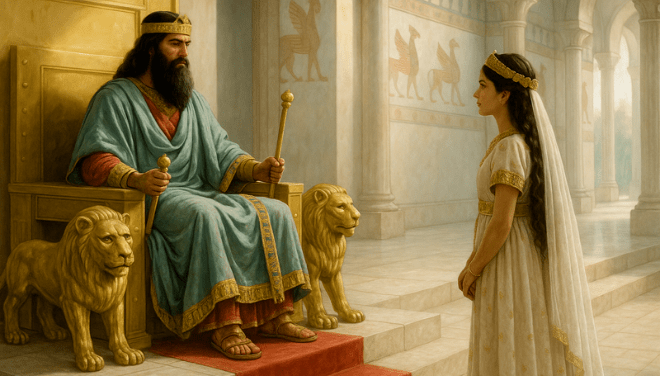
This week we continue and conclude our series on women of the Old Testament by turning our attention to Esther. We’ve already spent time with Hannah in her faithful prayer, Tamar in her righteous justice, Ruth in her loyal love, and Deborah in her prophetic leadership. Today, we come to Esther—whose story shows us that God’s timing is always perfect, even when ours is not, and that his timing is always aimed toward freedom.
The Persian Empire—massive, shiny, and full of people wearing what I can only describe as very complicated outfits—was the biggest thing going in Esther’s day. It stretched from the Indus Valley in the east to the Aegean Sea in the west, which is a lot of space for one empire to cover, especially without GPS or Amazon Prime. They kept it all together with roads, messengers, and an impressive ability to conquer other people and then keep them under control without too much fuss.
Now, the Jews didn’t exactly choose to live there. About 150 years before Esther, the Babylonians had smashed Jerusalem, wrecked the temple, and dragged many Jews away from home. Then the Persians came along, beat the Babylonians, and suddenly the Jews were their responsibility—like inheriting a whole nation in a swap deal nobody asked for.
Some Jews went back to Jerusalem when the Persians allowed it, but many stayed where they were, building lives in cities like Susa. That’s where Esther’s story happens. Her Hebrew name was Hadassah. She was an orphan, raised by her cousin Mordecai, and somehow—probably not through an ancient version of The Bachelor—she became Queen of Persia, married to King Ahasuerus. His name sounds a bit like someone sneezing into a trumpet, which must have made introductions awkward. One of his many titles was “King of kings”—a name meant to declare the power of Persia’s ruler, but one that, centuries later, we take on our lips for Jesus alone.
But back to Esther. Being queen was nice and all, except the royal crown didn’t stop a royal mess: a plan was underway to wipe out her people. Esther’s only real chance to help was to go to the king uninvited, which in Persian court protocol was a bit like showing up at the Oval Office without an appointment.
Esther’s trouble was simple but deadly. A royal edict had been issued—death for her people. She was in the palace, yes, but the rules of the kingdom were clear: you didn’t just walk into the throne room. Not even the queen. One wrong move, and the king’s guards would carry out the sentence before she could speak a word. A very efficient way of keeping the calendar free of unnecessary meetings, I suppose.
The challenge wasn’t just danger—it was timing. We often think the right thing will come with the right time neatly wrapped up. But for Esther, the moment came when she least wanted it, when every instinct said, “Wait. Let someone else go first.”
And here’s where we remember, as we always do in this series: grace doesn’t start with her actions. Grace began when God set her in place, when he preserved her life through exile, when his Spirit stirred Mordecai to speak those words: “Who knows but that you have come to your royal position for such a time as this?”
That’s not human guesswork—that’s the call of the Spirit, friends. She didn’t manufacture the moment. She answered it. Grace had prepared her place, her voice, her opportunity.
And so Esther stepped into the moment. She risked her life to stand before the king. And when the king extended his scepter, the door to liberation swung wide open.
Recall our second lesson today. Jesus sees a woman bent over for eighteen years. He didn’t wait for a “better day.” He didn’t check the Sabbath rule book first. God’s time had come, and he acted. Liberation doesn’t wait when God says “now.”
Emanuel, Esther heard the Spirit and answered. Will we?
We may not face Persian courts, but we live with unwritten rules about what’s safe to say or do. You know the ones—rules that aren’t written down anywhere, but you feel them when you step too close to certain topics at work, or when you’re at the family table and you can sense the conversation turning tense.
It might be when a coworker or classmate makes a comment that cuts down someone’s dignity, and the room goes quiet because nobody wants to be “that person” who speaks up.
It might be when a friend starts talking about immigrants with prejudicial talking points or another friend talks about folks from rural parts as uneducated, isolated, and bigoted, reducing them to ideological caricatures instead of living, breathing people made in the image of God we’re commanded to love. You know you should say something but your mind races with what it might cost you.
It might be when a loved one shares they’re struggling with depression, and everything in you says to change the subject because you don’t know what to say—but the Spirit nags you to stay in that hard, holy moment.
We can get tangled in our own timing, convincing ourselves we’re “just waiting for the right moment,” when deep down we’re hoping the moment will pass so we won’t have to risk anything at all. And sometimes, by the time we’re ready, the door has already closed, the opportunity gone, and the chance to speak or act for someone else’s freedom has slipped away. We forfeit our Christian responsibility. We fall short of the glory of God. We sin by what we leave undone…
But here’s the good news: God’s timing isn’t our timing—and thank God for that. He doesn’t wait for us to be perfectly ready. He moves toward freedom, even when we’re hesitating at the edge. The Spirit nudges us forward. In fact, sometimes she drags us, kicking and screaming—if just on the inside. She uses conversations we didn’t plan, transforms moments we didn’t schedule for her purposes.
And when we step into those moments, we’re not stepping into emptiness. We’re stepping into what Hebrews calls the unshakable kingdom—a kingdom that cannot be moved, even when the world shakes around it. We’re standing on the same solid ground that held Esther in the palace and the bent-over woman in the synagogue.
Today’s psalm says it simply: “In you, Lord, I have hoped.” That hope isn’t wishful thinking—it’s trust. Trust that the one who calls you into the moment is already there, and that his timing is always for salvation, restoration, and freedom. And in a few minutes, we’ll hold in our hands the sign and seal of that trust. In bread and wine, the promise of today’s psalm takes on flesh and blood—the God who has been our rock and refuge becomes our food and drink, our strength for the risk and the road ahead.
Communion is God’s act of grace in our time—right here, right now—and at the same time his act of grace in his time, the eternal now. When we come to the table, we’re trusting that his timing never falters, that the same God who met Esther in her moment meets us in ours. We eat and drink believing that his moment for our liberation, for our courage, for our faithfulness is not sometime far off—it’s always now.
From the table, the mission begins. We don’t walk away from bread and wine as if nothing has changed. The same Spirit who met Esther in the palace, who freed the bent-over woman in the synagogue, meets us here and sends us out.
The Spirit is still speaking, still using moments with people who will step into them. We may feel the clock ticking, the stakes rising. We may feel the weight of the risk. But we’ve seen what happens when God’s “now” arrives—walls fall, chains break, lives are set free.
So listen.
Watch.
The next conversation, the next interruption, the next unexpected door—it may be your “such a time as this.” Step into it. You’re not walking into a throne room alone.
The King of kings is already there.
 The Rev'd Daniel W. Spigelmyer, Jr.