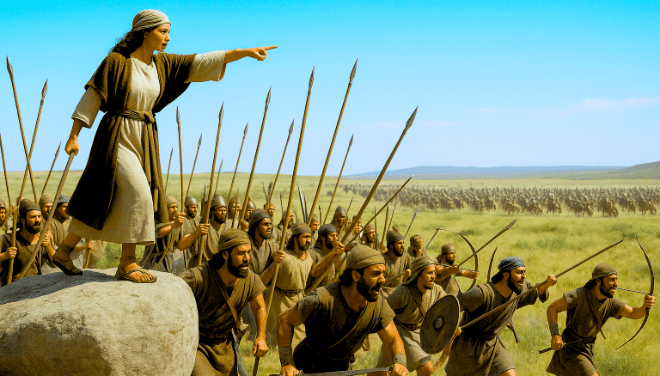
This week we continue our series on women of the Old Testament by turning our attention to Deborah. We’ve heard Hannah’s voice rise in prayer through her tears, and we’ve watched Tamar step into risk so justice could be done. We’ve walked the dusty roads with Ruth, whose loyalty carried her into a new life. And now we meet Deborah—already out in the open, unflinching, her eyes on the horizon where God’s word is about to become reality.
Deborah sat under her palm tree most days. It was her spot. Back then, before Israel had kings like Saul or David, things worked differently. When trouble came, there wasn’t a palace or a crown to turn to—there were judges. Not the kind in a courtroom with robes and gavels, but people who somehow rose to the moment when everyone else was looking around, wondering what to do. Israel was more like a family of tribes than a single nation, held together by shared stories, promises to God, and the kind of faith you pass down around the fire at night.
Judges didn’t get their position from an election or a title. People followed them because they’d proven themselves—maybe in a fight, maybe in keeping the peace, maybe because you could tell God had a hand on them. Usually, they led just a few tribes nearby, but that was enough. They could call warriors to defend the land, settle arguments before they tore neighbors apart, and remind everyone what it meant to belong to God.
Deborah was one of those leaders, and she was also a prophet—someone who heard God’s voice and could help everyone else hear it, too.
In other places, anthropologists might call them “big men,” people who didn’t rule with force but with trust, family ties, and the power to bring others together. Archaeologists have found bits and pieces from those years—simple farm villages, no big stone fortresses, no full-time army. Just small communities figuring out life between the hard work of planting and the harder work of staying safe. It was a time in-between—after the first days in the Promised Land delivered to them by God through Joshua, before kings—when God’s people learned how to stand together, even without a throne.
Judges, like Deborah, were the kind of leaders God raised up to guide the people, settle disputes, and help them live in God’s ways.
But back to the palm tree. The palm tree wasn’t just shade. It was a landmark. People could see it from far off and know help and wisdom were there.
One day, God spoke to her—clear as the wind through the branches: It’s time. Tell Barak to get the army together. I’m going to give the Canaanites into your hand. She found Barak, told him exactly what God had said. He didn’t say no, but he didn’t exactly say yes either. “I’ll go,” he told her, “but only if you go with me.”
Deborah didn’t flinch. “I’ll go,” she said, “but the victory won’t be yours. God will give Sisera into the hands of a woman.” Sisera was the commander of the Canaanite army—the one with unstoppable iron chariots that had bullied Israel for twenty years. Deborah didn’t say the woman’s name—maybe she didn’t even know it yet—but God did.
Later, standing on the ridge, she could see the enemy’s chariots glinting in the sun, iron wheels ready to crush anything in their path. She turned to Barak. “Go. Hasn’t the Lord gone out before you?” And in that moment, the waiting ended. The shouting began. The people surged forward. Sisera’s army collapsed in the chaos, and he ran—on foot, of all things—until he found the tent of Jael, the wife of a man whose family had ties to his own people.
Jael welcomed him in, gave him milk, told him to rest. But when he fell asleep, she picked up a hammer and drove a tent peg through the soft spot right in front of his ear. That’s how the commander who had terrified Israel for two decades ended up delivered into the hands of a woman—just like God said.
If you looked at the situation through the lens of cold reality, it was impossible. The Canaanites had iron chariots—military technology far beyond anything Israel could match. On an open field, those chariots would cut through foot soldiers like a knife through butter. The odds were measurable, and they were crushing.
Then add the cultural equation: Deborah was a woman in a patriarchal society, commanding men in war. The statistical probability of her even being in that role was near zero. And beyond the military and social forces, there was the spiritual tension—she wasn’t just planning a strategy; she was speaking for God into a nation paralyzed by fear. She was facing resistance not only from the enemy, but from within her own ranks.
Here’s where the equations break. In any human analysis, the outcome of that battle should have been predictable—and tragic. But grace isn’t constrained by the variables we can calculate. God had already declared the result: “I have given them into your hand.” The Spirit’s call was clear, and Deborah’s role was to trust that God who had gone before them would also be with them.
God’s initiative shifted the entire framework. It wasn’t Deborah’s boldness that originated the plan. The sequence began with God’s word, moved through Deborah’s obedience, and unfolded in real time on the battlefield. The outcome wasn’t a statistical anomaly—it was divine certainty manifesting in history.
Deborah’s response wasn’t a reaction to the elimination of fear—it was action in the presence of it. She stepped forward knowing the physical odds and cultural headwinds, yet confident in the greater constant: God’s promise. And what followed became a permanent feature in Israel’s collective memory—her song of victory and her leadership still echo thousands of years later.
This is where her life meets ours. She heard the Spirit and answered. Will we?
We face our own “iron chariots” today. They may not roll on wheels or carry spears, but they’re no less intimidating. They’re the entrenched wrongs we can’t imagine dismantling, the crises that overwhelm entire communities, the fears that paralyze us from acting. And here’s the deception—we think we have to wait for the fear to vanish before we can begin.
But that delay is its own form of defeat. If we’re honest, some of us have been stalled for years, waiting for better conditions, clearer signs, or guaranteed results. We’ve confused courage with the absence of fear, when in truth courage is what moves precisely because faithful fear is still in the room. There’s a kind of fear that paralyzes—and that’s the one we know too well. But there’s also a faithful fear, the kind that stands in awe of God’s power and trusts him enough to act, even when the outcome isn’t clear. Faithful fear doesn’t freeze you. Faithful fear leads you forward.
Here’s the breakthrough: Hebrews reminds us that we’re surrounded by a great cloud of witnesses, Deborah among them, calling us to run with perseverance. Today, St. Luke shows us Jesus, whose presence burns away false peace and demands action in the now. And today’s psalm gives us the image of God’s shining face restoring us, energizing us, making us able to stand. They reinforce this notion of faithful fear begetting courage.
The grace we need doesn’t come from our own internal reservoirs—it comes from God who goes before us. And that grace reaches into the very places we already know are spiritual but still frighten us. It’s the courage to step into a hospital room and pray aloud for someone when you’re not sure what to say. It’s the trust to answer God’s call to speak openly about your faith when you know the conversation might change the dynamics of a friendship. It’s the willingness to forgive when the hurt is still raw.
It’s also the courage to walk into a world that’s bent by deep wrongs—where power often crushes the weak—and refuse to be silent. To speak truth when others say “choose the lesser of two evils” as if that were the only way forward. To reject the idea that your Christian life is something separate from your public life, because in Christ there’s no dividing line between the two. The same Spirit who gave Deborah courage gives it to you—to stand, to speak, to act—in every arena of your life, even when it’s with faithful fear.
This is the hour to move forward—every hour is the hour to move forward. We will not wait for fear to depart before we take the first step. We will not surrender the future to what intimidates us in the present. God who called Deborah calls us still.
So we go—into our homes, into our community, into our places of work, into our schools—knowing that the same Spirit who stood with her stands with us. The road ahead may rise steeply, and the obstacles may crowd close, but we are not alone on it. And as we act in faith today, we plant courage in the soil for tomorrow.
Let it be said of us, as it is of Deborah: they heard the Spirit, and they answered with courage in faithful fear.
 The Rev'd Daniel W. Spigelmyer, Jr.