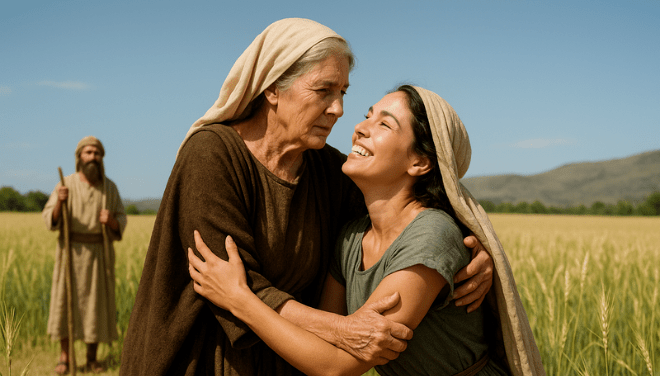
This week we continue our series on women of the Old Testament by turning our attention to Ruth. We’ve already stood beside Hannah as she wept and prayed for a child, and we’ve watched Tamar risk her body and her dignity to bring justice to a broken family and for herself. And now Ruth.
Her story is quieter. She doesn’t bargain with God. She doesn’t uncover corruption. She doesn’t cry out in the temple. Ruth doesn’t raise her voice at all. She simply stays. And sometimes, that’s the most radical thing a person can do. There’s a kind of grace in staying put, in showing up day after day without certainty or applause. A kind of holiness called forth and sustained by staying power—God’s staying power.
The story opens with loss. Naomi, Ruth’s mother-in-law, has buried her husband and both her sons. Her family line has ended. The land she lives in is foreign, the future empty. In that darkness, she turns toward home. Back to Bethlehem. She tells her daughters-in-law to go, to go back to their own mothers. To their own gods. To the possibility of new husbands. There’s nothing left for them with her. One of them, Orpah, kisses her and leaves. But Ruth, Ruth clings. And then she speaks what may be on the list of top ten most beautiful words in all of Scripture: “Where you go, I will go. Where you lodge, I will lodge. Your people shall be my people. Your God my God.”
She gives up her homeland. Her kin. Her culture. Her religion. Her future. All for love. Not romantic love. Not the love of prosperity. But love rooted in loyalty. In covenant. In presence. Ruth becomes the anchor of Naomi’s life. And through her, a future none of them could have imagined begins to grow.
But make no mistake. Ruth walks straight into danger. She’s a foreigner. A Moabite. From a people whose god was not Israel’s and whose story ran alongside, but never with, Israel’s own. She’s a widow. She’s poor. She has no legal standing, no protection, no certainty. She’s a stranger in every possible way. And still she goes. Still she loves. Still she stays. She chooses not the safe path, but the faithful one. Not the culturally appropriate decision, but the gospel one—though she wouldn’t have called it that.
What Ruth faces isn’t just hardship. It’s vulnerability that rips out the seams of the very fabric of life by sin itself. And she walks into that vulnerability with her eyes open, all for the sake of someone else.
And where is God?
God never speaks in this story.
No miracles. No visions. No sweeping flood to reset the world. No hellfire and brimstone consuming an inhospitable city. No talking, burning bush. No fire cascading down from heaven. But grace is everywhere. In the fields where Ruth gleans. In the arms that still welcome her. In the quiet hope that begins to flicker in Naomi’s face. In the moment Boaz sees her not as a burden, but as a blessing. But the most profound act of grace comes not from the sky—but from Ruth herself. Because sometimes, the voice of God is heard not from heaven, but from a human mouth. Ruth didn’t hear God’s voice. But Naomi heard Ruth’s. And that was enough.
Ruth responds to something the text doesn’t even name. Call it the Spirit. Call it love. Call it mercy. Whatever it was, she answered it. And that answer became grace in motion.
Ruth responds with loyalty. With courage. With presence. She doesn’t ask for anything. She doesn’t make a plan. She just walks. One foot after the other. One kindness after another. Until the field blooms, the hunger ends, and Naomi holds a child in her arms again. Ruth becomes an icon—not of perfection, but of faithfulness. She doesn’t part seas. She doesn’t win battles. She shows up and refuses to walk away. She has staying power.
She heard the Spirit—and answered.
Will we? Will you?
You can—with God’s constant, abiding presence. You can—with the Holy Spirit comforting, goading, inspiring, disquieting you. It’s not our strength, but God’s that sees us through.
We say we want to trust God. But what we often mean is: we want a sign. A flash. A clear voice telling us where to go, what to do, how to be certain. But we live in Ruth’s world, not Noah’s, not Abraham and Sarah’s, not Moses’ or Elijah’s.
We live among empty fields, unfinished prayers, uncertain journeys. We live among silent group chats and ghosted texts, where the people we counted on disappear without explanation. We live among dim hospital rooms and more and more obituaries as we watch the friends we came up die one by one. We live among long, solitary afternoons in quiet living rooms or dens, with no phone calls coming in because no one uses the phone anymore it seems, and we wonder why God still has us here at all. Our anxieties, our fears are real. We’re afraid to love if we don’t know it will be returned. Afraid to stay if the road looks bleak. Afraid to walk with others when we can’t see where the trail leads.
And yet…we’re still called. Still beckoned. Not to clarity. But to commitment. Not to certainty. But to trust. Because we are loved. We are accompanied along life’s way—even when we don’t know where we’re headed. God is who accompanies us. God is who loves us. God is who committed to us. God gives us our grounds for trust. Because we have first been loved, because we have first been accompanied, so we accompany and so we love. How can we who call ourselves Christians do any other?
Jesus says in today’s second lesson, “It is your Father’s good pleasure to give you the kingdom.” And Ruth—without knowing it—walks straight into that promise. She gives up her claim to safety. And God gives her a place in the royal line. She becomes the great-grandmother of King David. And in time, the ancestor of Jesus. But she didn’t know that. She wasn’t following a prophecy. She was following love. That’s what the kingdom looks like. Not certainty. Not reward. But covenant. Loyalty. Staying power.
So look around. Who has God given you to walk with? Who needs your presence more than your plan?
Faith doesn’t always look like belief. Sometimes, it looks like loyalty. Sometimes, it looks like love that clings through silence. Sometimes, it looks like Ruth. Sometimes, it looks like answering a text or an email you were sure you’d never get, and choosing not to ask why it took so long. Sometimes, it looks like sitting through the night in a vinyl chair and holding the hand of someone who repeats the same questions every five minutes with no recollection of having already asked ten times. Sometimes, it looks like getting out of bed when no one’s expecting you, going to Market Basket out of routine, and becoming the merciful moment in a stranger’s day when you give them a quarter to cover their bill.
Grace isn’t always cataclysmic or even immediately noticeable or intentionally figured out. In fact, it rarely is. Grace is so extraordinary as to be ordinary. Don’t wait for the sky to open. Look for the hand beside yours. That is where providence begins. Cling. Stay. Love. And trust that in the mystery of faith, death will not triumph and God will come to you again…and again…and again—or rather, that God is already and has already always been with you.
God who stays with us in ordinary silence gives us strength not our own, so that we can be what others need as he is for us. What he gives is nothing less than staying power—yours, but more importantly, his.
 The Rev'd Daniel W. Spigelmyer, Jr.