Today we begin our journey through the lives of women in the Old Testament by looking at Hannah. She’s not royalty. She’s not a prophet. She’s not a warrior. But she is a woman with a quiet voice and a burden the world has no room for. Her story—every thread of it—is soaked in the Spirit’s call.
Hannah lived in a time when a woman’s worth was bound tightly to what her body could produce. Sons meant status, survival, and legacy. Without them, a woman could be seen as failed, cursed, or expendable.
Her husband, Elkanah, was a Levite from Ramah. He had two wives. Peninnah had children. Hannah had none. The text notes this quickly, without ceremony, like a diagnosis in a case file. The details are sparse, but the silence in between them says more than most readers notice.
Elkanah was religious. He traveled regularly to Shiloh, the central sanctuary before the construction of Solomon’s temple. There, he sacrificed. There, he worshiped. There, he gave out the portions of the offering. Peninnah and her children received theirs. Hannah received a double portion. The writer tells us it was because Elkanah loved her. Whether that extra portion honored her or reminded her of what she lacked, we’re not told. But we are told that Peninnah used it as ammunition.
Peninnah provoked her year after year. Not occasionally. Not in passing. But as a pattern. As a habit. Possibly as a duty. And each year, at the very place where Hannah was supposed to find comfort in God’s presence, she was tormented by her rival.
Elkanah tried to help. He asked the question men have asked for centuries when they mean well but don’t understand: “Why are you weeping? Am I not more to you than ten sons?”
That’s where the file would close. That’s where the silence would deepen. Except Hannah got up and went to pray.
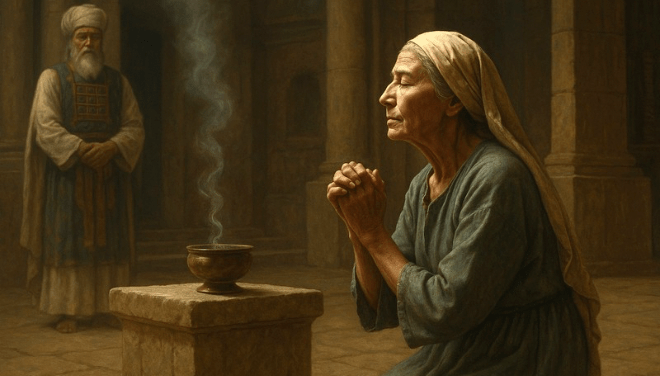
At Shiloh, the priest was Eli. Old. Tired. Perhaps dulled by years of routine and the failures of his sons. When he saw Hannah praying—silently, lips moving, voice gone—he assumed the worst. He thought she was drunk. His eyes saw a disruption, not a cry for mercy. His voice rebuked, didn’t comfort.
But Hannah replied calmly. She named her grief and corrected his assumption. “I have been pouring out my soul before the Lord,” she said. Eli, to his credit, backed down. He spoke a blessing over her. She rose. She ate. Her face changed.
Soon after, she conceived. She bore a son and named him Samuel, saying, “Because I asked the Lord for him.” And when he was weaned, she brought him back to Shiloh and gave him to the Lord, saying, “For his whole life he shall be given over.”
Then she sang. A song so potent, Mary, the Mother of God, will echo it a thousand years later. A song of reversal and righteousness. A song that tells the truth about the God who listens and acts.
She’s remarkable.
That’s her story. And here’s where it begins to meet ours.
Hannah bore trouble—real, aching trouble. She was mocked in her own home. She was dismissed by her faith leaders. She was misunderstood by the one who loved her most. She carried an absence no one could fill and walked through it with sorrow and dignity. That trouble didn’t make her bitter. It didn’t stop her from going to God. It made her pray.
The Spirit didn’t give her polished words or sacred formulas. The Spirit called her to come anyway. With all her heartbreak. With all her longing. With whatever dignity she had left. And she came.
She didn’t come to bargain. She came to pour herself out.
And God answered—not just by giving her a child, but by lifting her whole life. Grace reached her before her womb opened. Grace heard her before Eli did. Grace met her in the silence and shaped her into a vessel of hope.
She responded with faith. With trust. With song. She didn’t clutch her gift. She returned it. She didn’t retreat into privacy. She stood up and bore witness. And her story invites us to do the same.
It invites us to bring whatever we carry. To stop waiting until the pain is tidy. To pour out our souls. Not because we have the words. But because we trust the Listener.
We know what trouble looks like. We don’t need to go looking for it.
There’s a woman in her eighties who lives alone. Most of her friends have died. Her arthritic fingers don’t play the piano like they used to, but her memories are still sharp. She wonders why God has kept her here. She wonders if anyone still cares she’s around m.
There’s a man who spent his whole life working, raising kids, paying bills, volunteering at church. Now he’s retired. And the phone doesn’t ring much anymore. He wonders if what he did mattered.
There’s a teenager who scrolls through photos of everyone else’s perfect life and wonders if anyone sees her. Wonders if her prayers count. Wonders if she even knows how to start.
Hannah’s trouble is not locked in the past. It’s stitched into our present. Her silence echoes in our own.
And so does her grace.
The God who remembered Hannah remembers us. Grace isn’t a guarantee that everything we long for will happen. Even Jesus, when he taught his disciples to pray, didn’t give them magic words or bargaining tools—just a few simple lines: your kingdom come, your will be done. It’s not a formula. It’s trust.
But it is a promise. God hears. And we know that because Jesus trusted it, even in death. “Father, into your hands I commend my spirit”—Jesus last meaningful confession of faithfulness. The resurrection, as Paul tells us, is the loudest answer to the quietest prayer: God hears.
And Paul says something more in his second letter to the Corinthians.“We also believe,” he declares, “and so we also speak.” Prayer is not guesswork or wishful thinking. It is the voice of a relationship with God shaped by resurrection. God who raised Jesus is the same God who listens. The resurrection is proof that God has acted definitively, powerfully, and faithfully. So when we speak to him, we do so knowing, not hoping, that he hears and will act. Our prayer is convictional because “he who raised the Lord Jesus will raise us also,” Paul reminds us. The resurrection guarantees us not only Christ’s victory, but our future. We speak—we pray with boldness because we already stand within that victory. The Spirit of faith animates this speech. It isn’t private optimism but shared, scripturally rooted, resurrection-fueled confidence.
Grace looks like a church member who calls just to say, “I’m thinking of you.” Grace looks like a prayer whispered behind the steering wheel on the way to a chemo treatment . Grace looks like a journal entry a teenager writes and hides, because he’s too sacred to say it aloud—yet still a prayer.
Grace is not flashy. It’s faithful. It’s God, still acting. The Spirit, still calling.
So what do we do?
We do what Hannah did.
We pour out our souls—not perfectly, but honestly. We trust that silence isn’t absence. And when the Spirit brings peace or birth or song, we offer it back.
Because the God who heard Hannah hears you.
And the world still needs people who will pray and sing on behalf of what’s coming next.
And if you don’t know where to start, start where Hannah started. Or start where Jesus taught: Our Father, who art in heaven…
Hannah’s story doesn’t end with a baby in her arms. It ends with a prophet in the temple. And centuries later, it reaches fullness in Jesus Christ—not to replace her story, but to fulfill it. To carry it forward. To prove that the God who heard her is still listening now. And still acting. And still loving—still loving you.
 The Rev'd Daniel W. Spigelmyer, Jr.