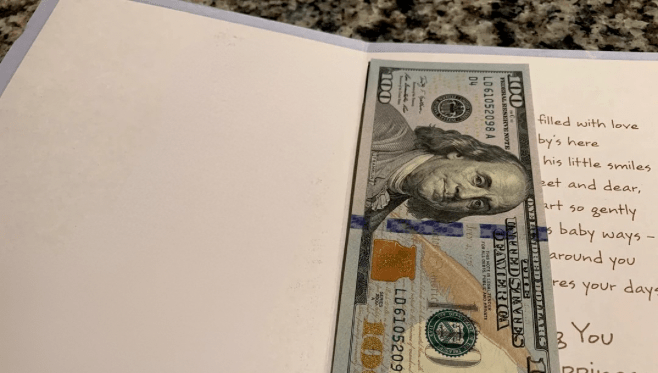
You know that feeling when someone you love gives you something—something small but full of meaning—and you don’t quite know what to do with it?
Maybe it’s a birthday card, with kind words and a little money tucked inside. You read the card. You feel the love. You say thank you. You even put the card on your fridge, where you’ll see it every day. But the money? You don’t spend it. Not because you’re ungrateful. Maybe just because you’re not sure what to do with it. Or maybe you forget it’s even there.
And sometimes, it’s because the person who gave it to you was really special. And you don’t want to spend that money because it feels like it’s part of them—like spending it would mean losing some part of what they gave. The value, for you, is in holding on to it, not in using it.
It’s easy to do that with gifts.
And it’s easy to do that with Jesus, too.
Because sometimes, when we talk about Jesus ascending into heaven, it can feel like the story is winding down. Like the party’s over, the chairs are stacked, the lights are turned off, and we’re left just holding the card. Remembering the good times. Maybe smiling. Maybe a little sad.
But Ascension Day isn’t the end of the party.
It’s not the end of anything, really.
Ascension is Jesus entrusting us with something. A mission. A co-mission. But also something far more. A promise. A gift. And we’re not meant to admire it—we’re meant to live it.
The disciples didn’t know that at first. Can you imagine them, standing there, necks craned, eyes to the sky, watching the soles of Jesus’ feet disappear into a cloud? And then the silence. That big, deep kind of silence when something important just happened, and you don’t quite know what to say.
They were probably holding their breath. Maybe hoping he’d come right back down again. Maybe wondering what they were supposed to do now.
But then the angels spoke: “Why are you standing there, looking up toward heaven?”
It’s a gentle question. It’s not meant to scold. It’s meant to wake them up.
Now—later in the story, we remember another moment like this. Another servant of God taken up in glory. Elijah, the great prophet, swept up in a chariot of fire. His apprentice Elisha watched it happen—watched him go—and cried out with sorrow and wonder.
But do you remember what happened next?
Something dropped from the sky.
Elijah’s mantle. The sign of his authority and calling. And Elisha picked it up. He didn’t build a shrine around it. He didn’t put it in a keepsake box. He put it on his shoulders and kept walking. He used it.
That’s what Jesus does in his ascension. He doesn’t disappear so we can miss him. He rises to the Father so we can carry what he’s left with us: a Spirit-drenched mission of hope, of witness, of love.
Because Jesus didn’t just disappear. He didn’t leave them empty-handed. He left them a gift. He had just said, “You are witnesses of these things.” He had just promised the Spirit, just blessed them, just given them all they needed. It was time to spend the gift. Time to live the mission.
And then he went.
He leaves so he can be with us in a new way—through the Spirit, through one another, through the work we’ve been given to do.
But even more deeply than that, we say in the creed: “For us and for our salvation, he came down from heaven.” God did not come in Christ to be distant. He came to be near, to live and walk and suffer and rejoice in the very dust and light and breath of this world. Every step Jesus took toward the cross was for us. Every word he spoke, every act of mercy, every moment of hunger and pain and prayer was part of God’s desire to bring us home. His descent into our lives wasn’t a visit. It was rescue.
And so too, for us and for our salvation, he ascends. Jesus doesn’t go to the Father to escape us. He goes to intercede for us. To prepare a place. To take his rightful place not just as Lord, but as the one who carries our humanity—your body, your story, your need—into the very heart of God. His wounds are not erased in heaven. They are glorified. He ascends not to separate heaven and earth, but to hold them together.
And in holy communion, that promise is made visible and tangible and true. Every time we come to the table, Jesus comes down from heaven—not as an idea, not as a memory, but in flesh and blood. And we, in our flesh and blood, are lifted to a foretaste of heaven. The happy exchange—the great mystery that God becomes like us so that we might become like him—is not a theory. It’s a gift. It is meant to be, and desired to be, by God himself. It is grace between us and God, and grace between one another. A gift to spend. A life to live.
And if we’re ever tempted to just hold onto the memory—just admire the card, without spending the gift—it helps to remember the next part of the story: Pentecost is coming.
So maybe today, we pause and ask: What gift has Jesus left in our hands?
What calling have we set on the shelf?
What promise are we meant to live, not just admire?
And then, in the quiet of that question, we remember: He went up—for us and for our salvation. Not to leave us. But to lift our eyes in hope. And to ready our hands for the work he’s given us to do.
 The Rev'd Daniel W. Spigelmyer, Jr.