Grace and peace to you from God our Father and our Lord Jesus Christ. Amen.
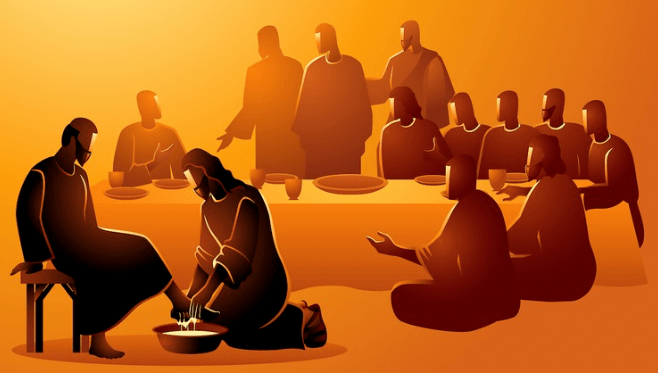
Tonight, we gather once again, as is our yearly custom, on a sacred occasion—an occasion that invites us to reflect deeply on the love and sacrifice of Christ. We remember the last meal Jesus shared with his disciples before his death. But this meal is more than just a moment in history—it is a command, one that still speaks to us today. At that meal, Jesus commanded us to love one another, but he didn’t simply tell us to love one another in words; he showed us how, through his action, through humble service and sacrifice. As he washed his disciples’ feet, he wasn’t just performing an act of kindness. He was setting a pattern for us—one that says love isn’t just something we feel. It’s something we do. It’s about giving ourselves away, even in the smallest, humblest ways.
This meal we celebrate tonight is more than bread and wine. It’s a promise. A promise that through Christ, we are formed into a new body. And that body is meant to live out his love in the world. We receive mercy, but we’re also called to carry it—to take it with us wherever we go. It’s in how we serve one another, how we love one another, even when it’s hard.
Perhaps the pinnacle of tonight’s ritual is the stripping of the altar. This act, stark and simple, serves as a powerful reminder of what Jesus endured for us—stripped of his dignity, his clothes, and left exposed to pain and mockery. This isn’t just a ritual. It’s a vivid image of the brokenness he bore for our sake. His body was torn apart, his life laid bare. And in that act of surrender, he gave us the ultimate gift. He sacrificed himself as he served us…He gave his body for us…He shed his blood for us.
“Maundy” comes from a Latin word meaning “command.” It’s the command Jesus gave us to love one another, just as he loved us. This night, we remember that love isn’t safe. It’s not comfortable. It’s messy, and it costs something. It cost Jesus something. And likewise, it costs us something. We look back to that first Eucharist, the meal that would be his last, and we see the depth of Jesus’ love for his disciples—and for us. In this meal, we’re called to a new way of living: a life of love, servanthood, and sacrifice.
The stripping of the altar isn’t just a ritual. It’s a preparation—a preparation for Good Friday, when we will once again stand at the foot of the cross and see the depth of what love truly costs. From there, we move into Holy Saturday and the Great Vigil of Easter. Together, the Great Three Days—Maundy Thursday, Good Friday, and Holy Saturday—with Easter morning are the high holy days of our faith. We can’t fully understand the resurrection without first embracing the weight of Christ’s death. These days are inseparable. They form a whole that leads us from darkness to light, from sorrow to joy.
So tonight, we enter this time of solemn anticipation. As we leave here in silence, we wait. We wait for what’s to come, but we don’t wait passively. We wait with purpose, with hearts open to the command of Christ to love and serve. How can we live out that love, here and now? How can we, like him, give of ourselves—humbly, sacrificially, and with mercy?
This love isn’t just about words. It’s about communion and sacrificial servanthood, where we give of ourselves as Christ gave of himself for us. It’s in this meal, in this sacrament, that we’re reminded not only of his love but of our call to live it out—through humble service to one another and to the world. And as we prepare for the coming days, remember: love one another, as he has loved us. This isn’t just about what we do tonight. It’s about what we take with us, into the world tomorrow, and every day after that.
In the name of the Father and of the Son and of the Holy Spirit. Amen.
 The Rev'd Daniel W. Spigelmyer, Jr.