The Christmas season spans twelve days, a season that begins on Christmas with the angel’s bold proclamation: “To you is born a Savior.” From that night in Bethlehem, the story of God’s incarnation unfolds—not just for us and our salvation, but for all people and for all people’s salvation. Each successive day unfolds for us to see more clearly the depths of what it means for God to step down from heaven and enter creation as one of us. This season culminates today, in the story of the Magi, seekers from distant lands who followed a guiding star to Bethlehem. Their arrival reveals the true scope of God’s grace: it isn’t confined to one people or one place. It is expansive, boundless, meant for everyone—even those who seem so different from us, living lives far removed from ours.
It’s fitting that this season ends with Epiphany, a day whose name means “understanding.” On this day, the purpose of the incarnation comes into sharp focus. We see, as if for the first time, that God’s grace isn’t ours alone. It is a light for all people, drawing every nation, ethnicity, and language toward the promise of hope, peace, and salvation. This is the heart of Christmas: not a message of exclusion, but a call to embrace the boundless reach of God’s love.
Let us pray. May only God’s Word be spoken and may only God’s Word be heard; in the name of Jesus. Amen.
Throughout history, people have been fascinated by predictions of the future, with hopes of finding meaning in the words of the so-called prophecies. There are oodles of predictions and collections of predictions the world and millennia over.
Take for example this one:
The great Pontiff of the party of Mars,
Will subjugate the confines of the Danube:
The cross will pursue the crescent,
In the confines of Persia, near a million.
Or this one:
Beasts ferocious from hunger will swim across rivers:
The greater part of the region will be against the Hister.
The great one will cause it to be dragged in an iron cage,
When the German child will observe nothing.
Or maybe this one:
At forty-five degrees the sky will burn,
Fire to approach the great new city:
In an instant a great scattered flame will leap up,
When one will want to demand proof of the Normans.
These three predictions are part of a much, much larger collection of many such so-called prophecies. You know who they’re from? That’s right. Nostradamus.
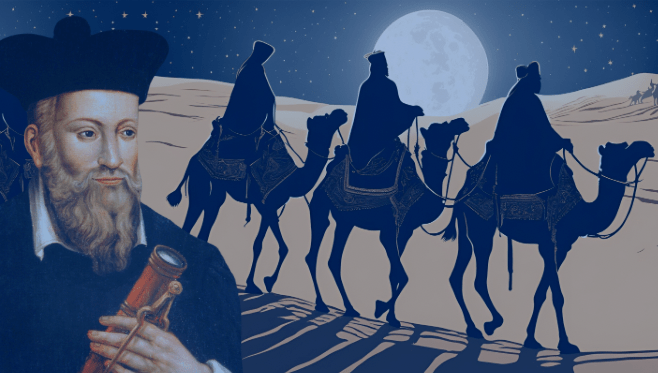
Nostradamus was a 16th-century French seer, and is perhaps the most famous of the folks many believe could see into the future. His 942 verses, collected in Les Prophéties, are divided into ten centuries, each containing 100 quatrains, short poems of four lines. These quatrains are cryptic and have often been interpreted as predictions of future events, covering wars, political upheaval, and natural disasters. Let’s take a peek at those three quatrains I just shared with you.
The first, from Century VIII, Quatrain 56, has been linked to Pope Urban II and the First Crusade in the late 11th century. Interpreters suggest ‘party of Mars’ aligns with warfare, and the ‘cross pursuing the crescent’ evokes the religious conflict between Christians and Muslims. Of the three, this quatrain seems to carry the most historical plausibility.
The second, from Century II, Quatrain 24, is often associated with the rise of Adolf Hitler and Nazism in Europe. The mention of ‘Hister,’ an old name for the Danube River, has been reinterpreted as a reference to Hitler, though this requires some creative reading. The imagery of beasts and destruction has fueled its connection to World War II. Perhaps…
And finally, the third, from Century VI, Quatrain 97, has been tied to the events of 9/11. The ‘sky will burn’ and the ‘great new city’ are read as references to the attacks on New York City. While vivid, this interpretation also requires significant eisegesis, or reading our preconceptions or biases—or agendas—into the text.
These examples remind us of the human tendency to look for meaning and patterns, even in the most cryptic of messages. But as we turn to Matthew’s account of the Magi today, we find a different kind of search—a search not for riddles to solve, but for truth and transformation, truth and transformation revealed clearly in the light of a star and more so in the person of Christ.
The Magi, like Nostradamus, were astrologers—learned men who read the stars, seeking wisdom from the heavens. Both interpreted celestial signs, but the similarity ends there. While Nostradamus’ prophecies were centered on human speculation, the Magi followed a star that pointed directly to Jesus. Their search wasn’t for cryptic predictions or hidden meanings, but for a transformative encounter with the divine, with sacred, with the numinous. And unlike the ambiguity of Nostradamus’ quatrains, the guiding star the Magi followed was clear and certain and led them directly to the King of kings.
The Magi and Nostradamus, and seers like him, share some striking similarities. Both were seekers of wisdom. Both looked to the stars for guidance. Both were learned men. Both studied celestial bodies and interpreted the signs they observed. The Magi, like those who look to the future through astrology and fortune-telling, had a deep knowledge of the world around them.
But the crucial difference is in what they sought. Seers and prognosticators seek to predict the future. Their focus is on interpreting patterns and events to gain insight into what’s to come. Their goal is often to offer glimpses of the unknown, to offer reassurance or, at times, instill fear about what lies ahead. The Magi, on the other hand, weren’t looking to predict the future. They were looking for the present. They were looking for the Savior. They weren’t trying to see distant prophecies unfold; they were following a star that led them directly to Jesus.
The outcome of the Magi’s journey was transformative. They encountered Jesus, and in that encounter, their lives were changed. They brought their gifts, they bowed in worship, and they returned home, no longer the same. Their quest for the present truth resulted in salvation, peace, and hope for them, in the midst of their own lives. The same is true when we, like them, follow the light of Christ, bow before him in worship, and give our lives in loving devotion in the same way he gave his own life—in sacrifice for the sake of others in obedience to the will of God the Father. Yes—salvation is a free gift, no doubt, but taking that gift, appreciating that gift—truly appreciating it for what it is—that’s where the transformative power of salvation matters today, this side of heaven.
In contrast, the outcome of the work of so many seers is ambiguous. Their predictions are often interpreted in many ways, depending on the perspective—and often motivations—of whoever’s interpreting them. They can be applied to any number of events, but they don’t offer the same clarity, hope, or transformation that the Magi’s encounter with Jesus does.
The star that guided the Magi was a beacon of clarity. It pointed directly to Christ. There was no confusion about what they were following. It was the light of God’s revelation and it led them directly—to the very house!—to the one who would bring salvation to the world.
Seers, on the other hand, offer vague and often contradictory predictions. Their prophecies are open to interpretation, more often than not applied after the fact to fit events. They leave us with a sense of uncertainty rather than clarity. And by seers here, I don’t just mean fortunetellers; the pundits, the politicos, the fear mongers in the media that simply are after more clicks and higher ratings—these are our doomsayer seers today.
The Magi exemplify wisdom rooted in faith. Their wisdom wasn’t based on their own intellect or knowledge of the stars alone. It was rooted in their belief that God was revealing something to them through the star—a sign of hope and salvation. Their journey was one of faith, and that faith led them to the life-changing encounter with Christ.
Seers, however, often evoke fear. Pundits and prognosticators predict wars, disasters, and upheaval and leave us anxious about the future. Human speculation without the inspiration of the Holy Spirit and the accountability of our fellow disciples of Jesus only deepens fear. The work of fortune tellers leaves us in the dark, to grasp for answers in a world filled with more than enough uncertainty already.
But as we consider these differences, we remember that the Magi weren’t led by human speculation or vague predictions. They followed a star that led them to Jesus. They were seekers of wisdom, yes, but their wisdom was rooted in faith and guided by God’s revelation. They weren’t searching for cryptic signs. They were searching for the anointed of God.
The star they followed wasn’t ambiguous. It wasn’t a riddle to be solved or a cryptogram to be deciphered. It was clear, like a light shining in the night sky, leading the way. And God is not vague or cryptic either. The light God gives us may not reveal every specific turn or answer every question in advance, but it is clear as daylight in what it does show us.
This is clear as daylight: God loves all people. God loves us. God loves you—so much so that he gave up everything it means to be God, stepping down from heavenly glory to become a human being like us. God didn’t come to us in power and majesty but in the frailty of a helpless, needy infant. God chose to share in our human experience, with all its struggles and limitations, so we would never doubt how deeply he understands and loves us.
This is clear as daylight: God’s love offers hope and provides comfort in the face of difficulty. When we feel weighed down by sorrow or fear, we can look to Jesus, who knows what it is to be one of us. He knows what it means to hunger and thirst, to grieve, to feel abandoned—abandoned even by friends, family, and even God. In Jesus, God’s love doesn’t remain distant or detached from our pain. Instead, he meets us where we are and lifts us up and offers hope that endures.
This is clear as daylight: even when life is uncertain and turmoil surrounds us, God does not abandon us. In the face of life’s darkest moments, God is with us, walking beside us. Yea, though I walk through the valley of the shadow death, I shall fear no evil, for you are with me…And at the very end, God sees us through our final struggle, through death itself, into the life and light of his eternal presence.
God doesn’t deal in fear. God deals in love—perfect love, love that casts out fear completely. The guiding star that led the Magi to Christ reminds us that God’s love is never meant to confuse or terrify us. Instead, it brings clarity, peace, and joy.
In a world filled with uncertainty, we can take comfort in this truth: Jesus, the light of the world, is the true guiding star. He doesn’t lead us into confusion, but into the clarity of God’s salvation. His love shows us the way forward—not in riddles, but in the light of his grace.
Let us recommit ourselves today to turn our eyes to this light, the one that is clear as daylight. Let us pursue the wisdom it offers, a wisdom that cuts through fear and darkness. Let us recall the Magi—their journey, their determination, their faith. They followed a star that didn’t waver, a light as clear as daylight, leading them to Christ Jesus.
As we follow that same star, we hold fast to the truth it reveals with a clarity that banishes worriment: God loves us with an unyielding love, God walks with us through every shadow, and God offers us hope and life beyond imagining. This light doesn’t flicker or fail. It shines clear as daylight—a star that never misleads, steadfast and certain, the very beacon of salvation itself—the light of Christ.
In the name of the Father and of the Son and of the Holy Spirit. Amen.
 The Rev'd Daniel W. Spigelmyer, Jr.