Grace and peace to you from God our Father and our Lord Jesus Christ. Amen.
Christmas is, in many ways, a season of sparkle. There’s something magical about twinkling lights on a cold winter’s night, the scent of pine and cinnamon filling the air, and the sound of carols echoing through shopping aisles and on the radio. We bake cookies, wrap presents, and gather with loved ones—treasured rituals that bring warmth to even the darkest days of the year. I imagine many of you have your own traditions. Maybe it’s trimming the tree while an old movie plays in the background or sharing a meal around a table laden with family recipes. Whatever your traditions may be, they remind us to pause, to celebrate, and to draw close to one another. And that’s a good thing.
But as we enjoy these moments, it’s worth asking: What is all of this pointing to? The lights, the music, and even the gifts are not the point. They’re the signposts. And tonight, we follow where they lead.
Luke’s gospel invites us into a specific moment in history. It begins with a census—a decree from Caesar Augustus that sent families like Mary and Joseph back to their ancestral towns to be counted. Augustus, the emperor of Rome, ruled over an empire that stretched from Britain to Egypt, and this census was more than paperwork. It was a reminder of his control. Taxes would be collected. The empire’s might would be reinforced.
For the Jewish people, this census was one more reminder of their subjugation under foreign rule. Their land, promised by God, was governed by a foreign power. They longed for deliverance, for the Messiah foretold by their prophets. Into this moment of political tension and spiritual longing, Jesus was born. His arrival didn’t come with pomp or privilege but in a manger—a feeding trough in a quiet, unassuming corner of Bethlehem. And yet, this humble birth would change the world.
It’s extraordinary to think about: the creator of the universe, the one who spoke galaxies into being, entered his creation. He chose to step into the chaos, the suffering, and the hope of that moment to bring peace—not just for his time, but for all time. And not with pomp and circumstance, but with humility and mundanity.
And this is the meaning of Christmas. The angel’s words to the shepherds still ring true today: To you is born this day in the city of David a savior, who is the Messiah, the Lord. Christmas is the celebration of God’s greatest gift: the savior, Jesus Christ, born for us. Amid the lights and traditions, we must pause to reflect on the profound truth of Christmas—that the creator of the universe entered our world to bring us salvation and hope.
A man once noticed a sign in a store window announcing that a traveling circus would be coming to town. The sign promised exotic animals, daring feats, and spectacular performances, all for the a decent price. It had been years since he’d seen a circus, and the thought stirred up childhood excitement. The man resolved to go. He logged online and bought his ticket. After finishing his work for the week, he excitedly printed his ticket, anticipating Saturday’s show. The next day, he made his way into town early, eager to catch the first glimpse of the show.
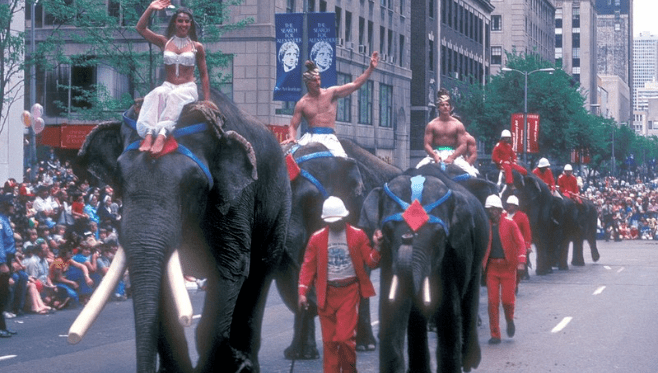
As he stood on the sidewalk, the circus parade began to roll through Main Street. Musicians played lively tunes, acrobats performed somersaults, and magnificent animals marched in step. Finally, the clowns danced past, spreading laughter, and just behind them came the ringmaster, dressed in a dazzling coat and top hat. The man, overwhelmed by the display, stepped forward and shook the ringmaster’s hand. “Thank you,” he said, “that was wonderful!”
Satisfied, he turned and walked back home. What he didn’t realize was this: he had only seen the parade. The parade was meant to excite and invite, but the real spectacle—the wonders of the circus—was waiting inside the tent. He missed the point entirely.
This story of the man at the circus reminds us how easy it is to stop at the parade and miss the main event. The lights, music, and even the traditions we hold so dear are wonderful, but they’re not the fullness of Christmas. They’re the signs pointing us toward something far greater.
The real wonder of Christmas is this: the creator of the universe entered into his creation. The one through whom all things were made didn’t stay distant. He came to us. He came for us. And he came not just to share in our joys but to enter into our brokenness, our need, and our longing for peace. For us and our salvation, God came down from heaven in Jesus Christ. For you and your salvation, God came down from heaven in Jesus Christ.
Jesus didn’t come to dazzle us with displays of power. He came humbly, born as a child in Bethlehem, to create peace and to make a way for us to be reconciled to God. He came to offer salvation and hope—not just to the world in some abstract sense, but for you and me.
So there you have it, simply, the meaning of Christmas: the celebration of God’s greatest gift, the savior, Jesus Christ, born for us, for you. The angel’s message to the shepherds is good news because it’s deeply personal: To you is born this day in the city of David a savior. And it makes all the difference. Christmas tells us that God has not forgotten us. He didn’t look at the chaos of the world and turn away. Instead, he came near. The light of the world steps into our darkness and brings salvation and hope for all who believe.
So this Christmas, let’s not settle for the parade. Let the lights, the music, and the traditions point you to the heart of the season: God’s gift of Jesus, born for you. In him, we find joy, peace, and the assurance that we are loved beyond measure.
In the name of the Father and of the Son and of the Holy Spirit. Amen.
 The Rev'd Daniel W. Spigelmyer, Jr.