Christianity is often described as an “end times” religion, and for good reason. Ours a faith foundationed on the belief that we live in a pivotal era—one that began with the life, death, and resurrection of Jesus. This marked the invasion of God’s kingdom into human history, an extraordinary event that signaled the start of the “last days.” Yet the story isn’t over. We inhabit a liminal space—the “already but not yet”—where God’s promises are in motion, but their ultimate fulfillment still lies ahead, as we await Jesus’ return. This perspective changes everything. It infuses our lives with a sense of urgency, hope, and watchfulness. Jesus warned his followers, Jesus warned us to be ready for the moment of his return, and the New Testament writers described Christians as a people caught between two worlds.
We are called out of the present age to live by kingdom values, even as we await the unveiling of God’s greater plan—a future as certain as the rising sun but shrouded in the mystery of its timing. This end-times lens equips us to face the challenges of the here and now. It provides a framework for enduring suffering and pressing forward in the face of everything that opposes God’s good design for us and for all creation. With God’s promises as our anchor, we can live with purpose today while keeping our eyes on the horizon. The story of Christianity isn’t one of waiting idly, but of leaning into a tension that propels us forward, preparing us for a future where all things will finally be made whole. With this reminder, let’s ponder again what God is revealing to us about this “already but not yet” time that we live in…as we wait.
Let us pray. May the words of my mouth and the meditations of our hearts be acceptable in your sight, O Lord, our Rock and our Redeemer. Amen.
There’s something about mornings. I love to sleep in—especially after long, busy days. There’s a certain luxury about sleeping in. Yet the morning itself also holds a special draw for me. I like being up, sometimes even before the sun, and feeling the day stretch open ahead. I find I’m often more productive, more in tune with the rhythm of things, if I’m awake and active early, setting my intentions and shaping the hours to come. But there’s a catch: for all my love of mornings and the satisfaction of a day well begun, it’s the act of waking up that’s the hardest part. There’s a small, stubborn moment, the groggy, heavy lifting of my eyelids, the coaxing of my body to get up. It’s strange how such a tiny transition can feel so difficult, so resistant, and requires more willpower than all the hours that come after. Each morning, it’s a familiar struggle—and a small victory, too. Waking up, even though I know the day will be good, takes intention. Yet it’s choice I have to make again and again. In that way, even though it might seem a bit overblown to say it this way, but nevertheless, in that way, waking up each morning is a hopeful, a hope-filled act.
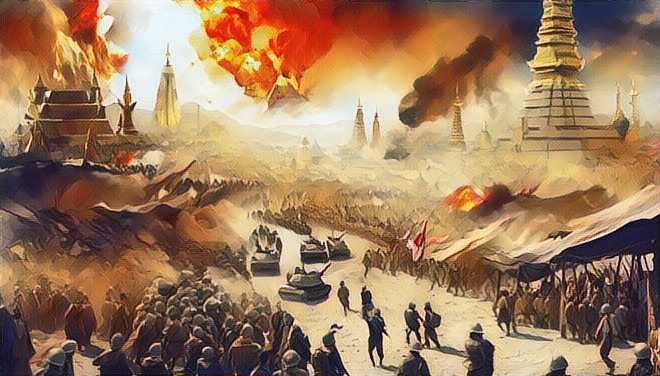
In today’s gospel, Jesus describes a scene that’s far more sweeping than the quiet transition of a single person waking up. He speaks of a day when the very heavens will shake, when the stars will fall from the sky, and when the mighty temple that once stood as the center of worship will be left in ruins. In that moment, all that we have trusted in—political systems, economic structures, social norms—will crumble, just as the temple in fact once did in 70 AD.
But this isn’t merely an image of devastation. It’s the precursor to something much greater. When the heavens shift and the earth trembles, when the trumpet sounds and the dead are called to rise, we will witness the fulfillment of God’s promise. The nations will be drawn together, our eyes lifted in awe to God’s right hand as he brings forth the full restoration of all things. In this moment, as the heavens themselves quake, the hope that sustains us won’t be disappointment but a glorious awakening. What a morning it will be—oh, what a morning—when the stars begin to fall from the sky and all creation turns its gaze upward. On that day, Jesus will return…oh, what a morning.
This is the prayer we long for: “Come, Lord Jesus.” It’s a prayer born of the trust that, in the face of all that will pass away, the new world that God has promised is far more glorious than anything we could cling to. In that great moment of awakening, when the trumpet calls forth the nations and all creation shifts with the movement of God’s hand, we will lift our eyes, and together as believers, we will shout with joy. We will join in the heavenly chorus. We will lift our gaze as the stars fall from the sky and the world is made new. It’s a prayer of longing not just for the end of this world, but for the coming of the next, a world made perfect, where love, justice, and peace reign. Where Jesus reigns.
We have a deep-rooted tendency to cling to what we know, even when God offers something far greater, and it’s not new. It’s present in the story of humanity from the very beginning. In Eden, we were faced with the ultimate test of trust: to believe God’s simple word or to entertain the serpent’s subtle questions. We knew God’s goodness and were given every reason to trust, yet we chose to explore the seductive possibility that God’s Word might be limiting, that perhaps there was a better way than what God had offered. This decision to trust the serpent’s insinuation over God’s promise reflects a fundamental human inclination—one that seeks the familiar paths of self-reliance, even when those paths may ultimately lead us astray.
This ancient choice reveals much about our current struggle to trust God’s promise of a renewed world. We are deeply conditioned to cling to what we know, to stay close to the safety of the familiar, even if that familiarity includes brokenness, sin, and imperfection. In questioning God’s promise of paradise restored, we betray our reluctance to release what we know for what we can’t yet fully see.
And yet, the invitation of “Come, Lord Jesus” calls us to something far greater than this inward hesitation. It calls us to step beyond the self-protective walls we’ve built and to open ourselves to a future shaped by God’s unbounded love and perfect will.
This mindset requires a significant shift, to move away from fear and toward trust. It invites us to surrender our instinct to cling to what is familiar—even when that familiarity includes the brokenness of our world—and instead to dare to hope for what God has promised. Today’s gospel calls us to an active anticipation, a watchful waiting, a hope that doesn’t hide from the reality of suffering and loss, but looks beyond it. We’re called to live each day awake, alert, and fully present, despite the weariness we sometimes feel, despite the temptation to settle back into what feels safe and known. And yet, just as sleep can be a necessary, restorative reprieve, there are moments in our spiritual journey when rest and recovery are part of our walk. These are times to step away from constant vigilance and to find refuge in God’s promises, to gather strength for the day ahead.
But ultimately, we’re reminded that this prayer—“Come, Lord Jesus”—is transformative. It’s not simply a passive wish, but a bold expression of faith and desire, an orientation of our hearts towards God’s future. We choose to trust that whatever must crumble in our world will pale in comparison to what God has prepared. And just as waking up each morning is an act of hope and a fresh start, each moment we turn our hearts to God’s promise, we are stepping into a deeper reality—a reality that Jesus assures us will never pass away.
The call here is both challenging and liberating. It’s a call to release our grip on the temporary and set our hearts on the eternal. And as we do, we discover that this prayer—“Come, Lord Jesus”—isn’t just about awaiting a distant future. It’s a present hope, transforming how we live today, stirring us to live in faith, hope, and love as we long for the day when God’s promises are fully realized.
Like morning after morning, each time we open ourselves to God’s promise, we rise again to new life, awake to the journey that God has prepared for us. Oh, what a morning it will be when, with the sound of the trumpet and the fall of the stars, we all lift our eyes to God’s right hand, and together, as believers, we shout with joy, knowing that, at long last, all things are being made new.
In the name of the Father and of the Son and of the Holy Spirit. Amen.
 The Rev'd Daniel W. Spigelmyer, Jr.