The saints have been a source of inspiration and debate in the Christian tradition for centuries. Some Christians pray to the saints as intermediaries to God, which raises concerns about detracting from Jesus as our sole mediator. A more faithful approach sees the saints not as intermediaries but as examples of discipleship. These men and women, our spiritual forebears, serve as role models who followed Christ, offering a glimpse of faithful living, even in adversity. Though death separates us physically, it doesn’t break our fellowship. Instead of praying to the saints, we should ask them to pray with us, just as we would with any living Christian. This approach respects the communal nature of our faith, recognizing the saints as still part of the body of Christ. So, how should we relate to them? Just as we would with anyone else in the church—as fellow members in Christ’s mission.
Let us pray. May the words of my mouth and the meditations of our hearts be acceptable in your sight, O Lord, our Rock and our Redeemer. Amen.
The word “creed” comes from the Latin “credo,” which means “I believe.” Creeds are simple-yet thoughtful-ways to express what we hold dear. A creed sums up our core beliefs, and while it often belongs to a religious community, it’s not always the case. Remember how Dr. Martin Luther King, Jr. spoke about this nation living up to its creed? He was talking about the foundational beliefs that guide us as a nation, rooted in life, liberty, and the pursuit of happiness for everyone. That’s our national creed, our national set of core beliefs, what we hold dear nationally. The church in the same way has simple-yet thoughtful creeds that express our core beliefs, what we hold dear.
In the early days of Christianity, the creeds we know today, like the Nicene, Apostles’, and Athanasian Creeds, came about during some very challenging times. The early church was full of different ideas and beliefs, and there were many debates, especially during the fourth century. These creeds were created to help the church stay true to what was believed to be the correct teachings about Jesus and the Trinity. It wasn’t always easy, and there were some heated discussions, but these creeds were important in defining and defending the true Christian faith.
When we look at the gospel of St. John as presented to us today, we see a beautiful conversation between Jesus and the Father, with the promise of the Holy Spirit woven in. Jesus says, “I am the way, the truth, and the life. No one comes to the Father except through me.” This statement really captures the heart of what we call Christian orthodoxy. Orthodoxy is just a way of saying “right belief” or “true belief.” It centers on the idea that Jesus is the path to God, the embodiment of divine truth, and the source of eternal life. Orthodoxy is all about what has been handed down to us as good and right for building our relationship with God and with each other in the church, both here in our parish and across the world. Anything that pulls us away from that good relationship with God, or that alienates us from the love of God in the church, is what we call heresy, or false teaching. God is love, and so everything about orthodoxy points back to that love—love that comes from God the Father, made real in Jesus Christ, and brought to life every day by the work of the Holy Spirit. That’s what orthodoxy is all about—right belief.
So far in our series on saints, we’ve talked about St. Patrick of Ireland, who showed us how to keep our relationship with God simple, and St. Lucia of Syracuse, who lived out grace and truth. Today, we’re going to look at St. Nicholas of Myra, who not only believed in the right teachings but lived them out in his actions, all under the guidance of the Holy Spirit.
Nicholas of Myra was born in the late third century in what’s now Turkey. He became the Bishop of Myra when he was 47. Nicholas was known for his deep compassion and unshakeable faith. He came from a wealthy family, but when his parents died, he gave away all his riches to the poor, quite like we heard about in Lucia last week. Nicholas faced persecution, too, under the same Diocletian Persecution as Lucia, and was even imprisoned for a time. He was famous for his secret acts of generosity, like providing dowries for poor girls so they could marry and helping those in need. These kind acts inspired the legend of Santa Claus that we all know so well today.
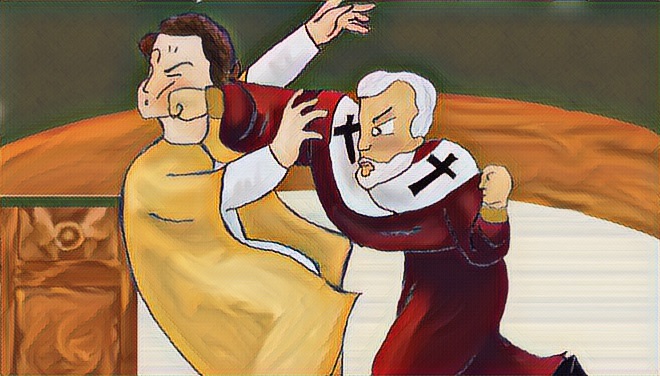
But Nicholas was much more than just the inspiration for Jolly Ole Saint Nick. He played a significant role at the First Council of Nicaea, where some very heavy theological discussions took place. Emperor Constantine called the First Council of Nicaea in 325 AD to address the Arian controversy. Arius, a priest, was going about teaching that Jesus wasn’t fully divine, which went against the orthodox understanding of the Trinity. Nicholas was so passionate about defending the true nature of Christ that he ended up punching Arius during the council. Now, that might seem shocking, but it shows just how committed Nicholas was to protecting Christian orthodoxy. (And you thought our council meetings could get heated!)
After this incident, Nicholas was temporarily stripped of his duties as a bishop, but he was later reinstated, showing that his orthodoxy was never in question. Nicholas continued to be a beloved figure, not just for his generosity but also for his strong defense of the true faith and his deep love for his community. Today, he’s celebrated around the world, not just as the origin for Santa Claus, but as a symbol of generosity, protection, and unwavering fidelity to the truth.
In today’s gospel, when Jesus tells us he’s the way, the truth, and the life, and that through him, we come to the Father—the source of all goodness, mercy, and peace—his disciple Philip asks a question about this truth business. He asks to be shown the Father. Jesus replies, “Anyone who has seen me has seen the Father. How can you say, ‘Show us the Father?’ Don’t you believe that I am in the Father, and that the Father is in me?” Later, Jesus promises, “I will ask the Father, and he will give you another Advocate to help you and be with you forever—the Spirit of truth.” Here, we see a beautiful, poetic Scriptural example of the mystery, God’s own revelation of the Trinity in action. And remember—the Trinity is central to Christian orthodoxy, to true belief. Jesus shows us the Father and promises the Holy Spirit. He grounds our own relationship with God in the relationship between Father, Son, and Holy Spirit—an eternal communion of love and truth.
But orthodoxy isn’t just about knowing the right things in our heads. Orthodoxy is about a deep, personal relationship with God that involves our whole selves. This right belief, this orthodoxy, naturally leads us to right practice, orthopraxy. Our faith in the Trinity should show up in how we live, how we love, and how we give. Orthodoxy and orthopraxy are like two sides of the same coin. When we believe in the Trinity, we’re called to live out that belief in practice—through justice, charity, and generosity.
The Holy Spirit’s role in all this is absolutely essential. We can’t even begin to believe in or accept Jesus as Lord without the work of the Holy Spirit. It’s the Spirit who helps us to do “greater things” that Jesus speaks of today, things we could never do on our own. Jesus calls the Holy Spirit the “Advocate,” who guides us into all truth and empowers us to live out our relationship with God. Without the Holy Spirit, our attempts to live out that relationship inevitably and necessarily fall short. It’s the Spirit who takes our orthodoxy, our right belief, and turns it into orthopraxy, right practice.
Nicholas is a wonderful example of what this lived orthodoxy looks like. His defense of the true belief and his acts of generosity weren’t just nice things to do; they were deeply rooted in his orthodox belief and guided by the Holy Spirit. His life shows us that our beliefs must shape our actions. As Christians, grounded in our belief in the Trinity, in a dynamic relationship within God bound up in love, we’re called to be a community where orthodoxy naturally leads to orthopraxy.
As we think about this, it’s important to ask ourselves how our beliefs are showing up in our daily lives. Are we, like Nicholas, allowing the Holy Spirit to inspire and empower us to live out our faith through acts of justice, charity, and generosity? How are we embodying the love of the Trinity in our interactions with others? What does that look like?
As a parish, we embody the love of the Trinity through our acts of discipleship. For example, as we prepare for Homecoming Sunday, we celebrate the ways we’ve served all summer through the God’s Work. Our Hands service project. Each week, as we see the pile of clothing for homeless and underserved children in the Fitchburg schools grow, we’re reminded of how God’s kingdom grows through our service—our right belief lived out in practice. By doing this and other things like it, we’re reflecting the kind of compassionate, action-oriented faith that Nicholas exemplified. And when our Bible study groups come together, we’re not just learning about the Word. We’re thinking about how these insights can be lived out in our everyday lives. We’re not just hearers of the Word, but doers of the Word, as St. James would say.
But discipleship isn’t just about what we do as a parish. It’s also about what we do as individuals. For each of us, prayer and worship are key ways to allow the Holy Spirit to inspire and empower us. When we make time for intentional, daily prayer, we’re opening ourselves up to God’s guidance. We’re having a conversation with God, and the Holy Spirit shows us opportunities to act according to God’s will. And when we come together in worship, we’re not just going through the motions. We’re reaffirming our commitment to Jesus’ teachings, confessing true Christian teaching in the creed, and we’re recharged—both spiritually fueled up and given directions—to serve others as Jesus has served us. Lastly, giving—whether it’s our treasure, time, or talents—is both personal and communal. It’s a reflection of a life modeled on Nicholas, and ultimately a life modeled on Jesus, who gave us everything, even his very own life. This kind of giving, inspired by deep trust, commitment, and belief in God’s provision, is a powerful expression of our orthodoxy lived out in orthopraxy—of our belief lived out in practice.
In Nicholas of Myra, we find inspiration for ourselves—a man who embodied the essence of orthodoxy, who lived out right belief with unwavering conviction. But Nicholas didn’t stop there. His orthodoxy was never static. It was always in motion, translating into orthopraxy, right practice, and guided by the Holy Spirit’s goading. His actions spoke louder than words, his generosity rippled through the ages, and his defense of the truth stands as a testament to what it means to live fully and boldly for God. We are called to be like Nicholas, to let our right belief fuel our right practice. In every act of kindness, in every word of truth, in every step we take in service to others, we live out the creed that shapes us, the faith that defines us. The Holy Spirit is our Advocate. She empowers us to do great things, greater things than even Jesus did—to turn our orthodoxy into orthopraxy, to make our beliefs a living, breathing reality in a world that so desperately needs it. This is our challenge, our charge—to live as people whose creed and deed are one, whose right belief leads to right practice. And so we walk in the footsteps of Nicholas, and so many others like him, who show us that true faith is never just a creed recited, but a way of life lived, a truth embodied, and a love shared.
In the name of the Father and of the Son and of the Holy Spirit. Amen.
 The Rev'd Daniel W. Spigelmyer, Jr.