A mystery isn’t something hidden, but something revealed or unveiled by God, meant to bring us to deeper understanding. The word “mystery” originates from the Greek “mysterion,” and quite literally means “something revealed or unhidden.” The Holy Trinity is a prime example of a mystery, something revealed: one God in three persons—Father, Son, and Holy Spirit. This is God’s own identity and central to our confession of faith—and it’s unveiled by God himself. Take also “mystery of faith.” That sums up all of Jesus earthly ministry—his death, resurrection, and promise of return, celebrated in communion—the clearest revelation of God’s mercy, grace, and love for us. These mysteries invite us into a relationship with God and continually reveal his love and grace for us. Exploring them deepens our faith and guides us to live out God’s love in the world more faithfully as a reflection of that very same love.
Let us pray. May only God’s Word be spoken and may only God’s Word be heard; in the name of Jesus. Amen.
Let’s delve right into it, shall we? Jesus’ parable from today’s gospel, particularly the one about the mustard seed, sets the stage for understanding how God’s kingdom starts small and grows beyond expectation. This simple seed, the smallest of all, some translations say, holds within it the potential to become something grand and significant. Jesus, in short, is teaching us that from humble beginnings, remarkable outcomes can emerge. We’re reminded never to underestimate the power of small actions and God’s ability to make his will happen through them.
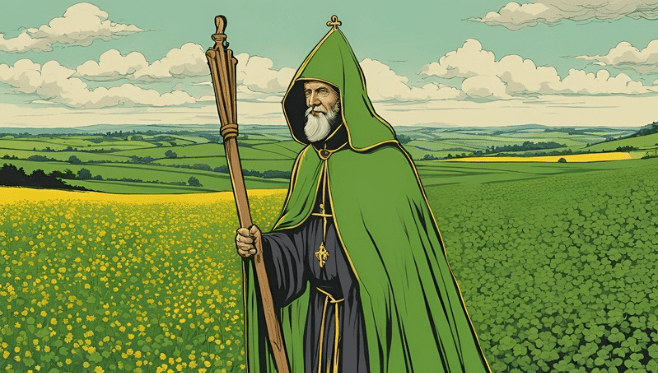
Speaking of underestimating smallness and God’s will, today we’re diving into the amazing story of St. Patrick—yes, that guy whose day we celebrate with corned beef, green hats, and Guiness. But did you know he has a Scottish twist? That’s right! St. Patrick, also known as Padraig in Irish, was actually born in what is now Scotland. Interesting coincidence, no?—especially for the Scots-Irish rivalry that’s been going on for centuries!
When he was just sixteen, Irish pirates snatched Patrick up and took him to Ireland as a slave. After six years, he escaped after having a vision told that him to break for freedom. He escaped all the way to France to learn, where he studied Latin and theology, where he was ordained a priest and bishop.
Later, Patrick went back to Ireland as a missionary. He worked tirelessly to spread Christianity and is famous for a legend where he supposedly chased all the snakes out of Ireland. His incredible journey and achievements made him a key figure not in only Irish culture, but also the world over, and the spread of Christianity in general.
Patrick, in addition to his reputation for driving snakes from Ireland, is known for using a shamrock to teach the Holy Trinity. He demonstrated how simple, everyday objects can reveal deep spiritual mysteries. The shamrock, a common, even abundant plant, became a powerful tool in Patrick’s hands. He used it to reveal a complex concept, the Trinity—three persons in one God, one God in three persons. Patrick’s brilliance lay in his ability to take something familiar and use it to open minds and hearts to God’s mysteries, to quite literally reveal God. He shows us that deep spiritual insights can be conveyed even through the simplest means, so that the profundity of complex truths can be accessible to everyone.
Both the mustard seed and the shamrock, small and seemingly insignificant, reflect the humble beginnings from which great things emerge. Patrick’s using the shamrock shows the power of simplicity in explaining the complexity of God’s identity. Just as the mustard seed grows into a tree providing shelter, Patrick’s shamrock helped people grasp the mystery of the Trinity. Both this parable from Jesus and the way that Patrick applied it, not using a mustard seed, but using a shamrock, show us how the ordinary aspects of life convey deeper spiritual meaning. It reminds us that God’s work often starts in modest, unnoticed ways, yet blossoms into something magnificent and far-reaching. In short, God shows up in the simple things. The ordinary reveals the extraordinary.
Recognizing the potential for small, ordinary things to reveal God’s presence means looking for God active in our daily lives. It requires us to pay attention, to pay attention to the world around us and see it through the lens of our relationship with God. Every day is filled with opportunities where God is quietly at work, and it’s our task to discern these moments. The Holy Spirit helps us. Discernment is one of her gifts, after all. She guides us by making us mindful and present. When she opens our eyes, we more readily see the subtle ways in which God communicates in our lives, each and every day.
Just as Patrick used the shamrock to explain the Trinity, we can find everyday items and experiences to understand our spirituality and discipleship better. Abstract, heady ideas become more concrete, relatable, tangible, meaningful realities. Moreover, we come to realize and believe that our small acts of kindness, though they might seem insignificant, ripple through other people’s lives. They impact the world in unexpected ways and they unveil, they reveal, they demystify God’s love and grace in truly practical terms.
Take a high school student on a basketball team. His relationship with God might show through in everyday actions like encouraging teammates or showing good sportsmanship in congratulating a winning, opposing team after the game. His example might also be good for us all in this tumult of political rancor between two deeply entrenched rival sides. Or someone working in an office might check in on a stressed coworker, maybe inviting them over to the house or out to each, offering support and company amid the rat race that popular wisdom cons us into thinking is a full life. Retirees aren’t exempted either. They can volunteer a few hours at a local charity—maybe the Historical Society?—or mentor kids in an after-school program. They’ve got wisdom for sharing and experience to draw from, and can make a true difference in the community. These seemingly small acts are huge—they’re seeds of God’s kingdom. They uplift others and reflect God’s love in ordinary interactions, in ordinary day-to-day life. They fulfill our call to bear God’s creative and redeeming love to the world.
We must be intentional in living out this simplicity. The devil’s grindstone has a way of complexifying and cluttering life; mindfulness of God’s simplicity keeps us on track. We must be attentive to the small things around us and see them as opportunities to experience and share God’s love. Come, Holy Spirit! We need to cultivate awareness and appreciation for the everyday blessings that come our way. When we value these moments, we become contented because we are living into God’s presence in our lives.
We must simplify complexity by seeing God in everyday, relatable, everyday things, just as Patrick did with the shamrock. This doesn’t just help reinforce our own understanding, but also helps others better understand the hope that’s within us. By drawing connections between the spiritual and the everyday, by seeing the extraordinary in the ordinary we deepen our trust in how God is woven into the fabric of our lives. Our hope becomes more and more tangible, and we grow into deeper relationship with God and in fervent love toward one another.
We must engage in small acts of kindness, and trust that they will grow into something greater in God’s kingdom. Whether it’s offering a kind word, lending a helping hand, or simply being present for someone in need, these small actions can have a true impact. They are like mustard seeds, seemingly insignificant at first but capable of growing into something beautiful and transformative. By daily recommitting ourselves to these small acts of discipleship, we participate in God’s work and contribute to the growth of his kingdom in our world.
Patrick of Ireland, the revered saint who used the simple shamrock to teach the Trinity, exemplifies the power of simplicity in our relationship with God. Just as the mustard seed grows from the tiniest seed into a mighty tree, our smallest acts of kindness and faith transform lives, communities, and the whole world. This is the heart of Patrick’s legacy—bearing witness, testifying, confirming that from modest beginnings, God’s kingdom flourishes in ways beyond our imagination. Through Patrick’s example, we see that in the seemingly insignificant, God’s extraordinary plans unfold and shape the world through our ordinary lives.
 The Rev'd Daniel W. Spigelmyer, Jr.