St. James speaks of the “law of liberty” in his epistle, emphasizing the central benefit of the gospel: freedom. In Christ, we find liberation not merely from external constraints but from the power of sin and death. We experience new life governed by grace and guided by love. This freedom isn’t license, but instead a transformative peace where life in Christ leads to righteous, sacrificial service.The gospel’s freedom extends beyond personal salvation; it necessarily means societal and communal liberation. It empowers each of us, no matter our lot in life, to advocate for justice, mercy, and equality, echoing the biblical call to “proclaim liberty throughout the land,” found in that all-too-favorite book of Biblical fundamentalists, Leviticus. Liberty and our work to secure it for others is God’s law. This freedom inspires us to challenge oppression and defend the dignity and rights of all people, reflecting the love and compassion of Jesus who didn’t discriminate whom he showed mercy or love to.
Emma Lazarus, a Jewish poet and activist, who wrote those iconic words engraved on the Statue of Liberty, “Give me your tired, your poor, your huddled masses yearning to breathe free, the wretched refuse of your teeming shore. Send these, the homeless, tempest-tost to me”—she wrote other words, more succinctly that remind us that true freedom involves collective liberty. “Until we are all free,” she writes, “we are none of us free.” A pithy inconvenient truth that echoes the call to Christian freedom, a call to love our neighbors as ourselves and to pursue justice for the disadvantaged and oppressed. Just as the gospel welcomes all who seek refuge and freedom in Christ, so too must we strive for a world where every person experiences the fullness of freedom and dignity. This is true freedom, freedom worth celebrating. We do well to remember that as we live as free Christians in the land of the free.
Let us pray. May the words of my mouth and the meditations of our hearts be acceptable in your sight, O Lord, our rock and our redeemer. Amen.
Mirrors are interesting, don’t you think? I really like mirrors. They help me reflect. There’s something fascinating about looking into a mirror and seeing yourself staring back. It’s a bit like having a conversation with yourself without saying a word. Mirrors have this unique ability to capture our attention, don’t they? Some people seem like they can spend hours just inspecting every little detail, every little imperfection, every little change.
Imagine all the stories a mirror could tell if it could speak. The joy, the sorrow, the laughter, the tears—all captured in a silent, unjudging reflection. Speaking of reflections, another important reason I have an affinity for mirrors is because my very own last name means ‘mirror merchant.’ The Spigel- part comes from the German word Spiegel, which means “mirror.” I must admit, working with mirrors is something I could see myself doing.
No matter what, a mirror will always reflect the truth—there’s no escaping what we see in the mirror, the good and the bad. It shows us who we are, unfiltered and raw, and sometimes, that’s exactly what we need to see to move forward.
Mirrors have fascinated humanity for thousands of years. Mirrors in mythology and literature often represent portals to other worlds or tools revealing hidden truths. Imagine holding an obsidian mirror, a mirror made of glassy black stone. Its dark surface reflects your face with a hint of mystery. These early mirrors were precious, and they symbolized self-reflection and truth, much like the polished copper and bronze mirrors of ancient Egypt and Rome. St. Paul writes about such reflections in copper mirrors in his first letter to the Corinnthians—“For now we see in a mirror, dimly, but then we will see face to face. Now I know only in part; then I will know fully, even as I have been fully known.” By the Renaissance, Venetian craftsmen perfected glass mirrors with metallic backings, capturing clear, vivid reflections. It could be that my German family were importers of such Venetian mirrors…or folks who worked for such an importer. Whatever the case, mirrors not only show us our outward appearance but they also invite us to look deeper, into the recesses of our souls.
The activity in today’s gospel acts as such a mirror, revealing truths about ourselves and our relationship with Jesus. Jesus returns to his hometown, and his disciples follow him. He begins to teach in the synagogue, and the townspeople are astounded. They ask, “Where did this man get all this? What is this wisdom that’s been given to him? What deeds of power are being done by his hands!” They’re puzzled because they see Jesus through the lens of familiarity, as “the carpenter, the son of Mary.” They can’t reconcile the ordinary man they know with the extraordinary works he performs. Their perception is a mirror reflecting their skepticism and lack of faith.
We, too, often look into mirrors clouded by our own misconceptions. We see ourselves as too common, too ordinary, too unholy to be instruments of God’s peace. But this is where God’s Word as a mirror becomes powerful. Through studying scripture, through preaching, through the promise of baptism and the promise of communion, we are reminded not only of God’s power, but of God’s mercy, grace, and faithfulness. Not only do we ourselves more clearly, but we see God more clearly. We see the relationship God has with us more clearly. We aren’t just flawed beings but we’re also beloved creations of God, marked with his image—both saint and sinner.
God’s Word is both law and gospel, at the same time. The law of God functions like a mirror, showing us our need for grace. It exposes our failures and shortcomings. When we look into this mirror, we see our sinfulness starkly. The law shows us our need for grace. It’s a mirror reflecting our inability to meet God’s standards. This realization can be painful, but it’s also the first step toward transformation. It’s this mirror function of God’s Word that we often resort to first, and often fail to move past. We stare incessantly at every imperfection we have before God. It’s uncomfortable, like seeing a blemish on our face, and can drive us to have an ugly self-image.
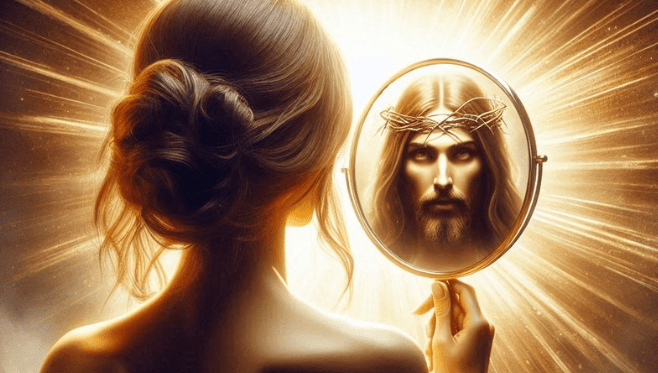
The gospel, on the other hand, just as much always God’s Word as the law, is also a mirror reflecting our inherent dignity as beings marked with God’s image from our very creation. In God’s mercy, Jesus Christ died for us, reconciling us to God and revealing our unsurpassable worth in God’s eyes. This mirror shows us someone loved so deeply by Jesus that he gave his life for them—we see ourselves, you see yourself. It doesn’t just reveal our flaws but prominently displays one redeemed. Unlike the law, which exposes our need for grace, the gospel shows us Jesus, who meets us in our brokenness with grace and forgiveness. This mirror offers hope, peace, and freedom. This mirror reflects not just our flaws, but the very face of one whom God loves. No one has ever looked in a mirror who doesn’t need God’s grace; nor has anyone ever looked in a mirror who doesn’t have inherent dignity and worth in God’s heart.
As Christians, we need to continually gaze into these mirrors. The Word of God, both law and gospel, reflects the truth. It demands that we acknowledge our sinfulness but also assures us of God’s grace. In today’s gospel, Jesus marvels at the unbelief in his hometown. Their familiarity breeds contempt, and they fail to see the Messiah standing before them. “Prophets are not without honor, except in their hometown, and among their own kin, and in their own house,” he says. This mirrors our own struggle with faith. We believe, but we need help in believing.
Think about shaking the dust off your feet, as Jesus instructed his disciples in today’s gospel as he sends them out to share God’s Word. Shaking the dust off your sandals is a vivid image that points to breaking away from the past, to leaving behind negative experiences and failures, not allowing them to define how you see yourself. How often do we carry the dust of past criticisms and failures with us? These are like smudges on a mirror that distort both our self-understanding and our understanding of Jesus. Shaking off the dust is an act of liberation, an act of freedom. It’s a call to leave behind what hinders us and move forward unburdened, to follow Jesus in loving ourselves and loving others as we love ourselves. But—we cannot love others as we love ourselves if we don’t actually love ourselves!
The townspeople’s reaction to Jesus shows how our perceptions can hinder us. They couldn’t see beyond Jesus’ familiar face to recognize his divine wisdom and power. We, too, sometimes fail to see Jesus clearly. Our familiarity with our own weaknesses hold us back from embracing the call to live free in the promise of God’s grace. But if we look into the mirror of the Word, truly look into it and what it actually reveals about God and us, we can’t help but to see differently. We see that despite our sinfulness, we’re God’s beloved creations.
This transformative vision is crucial—reflected in the cross. Just as mirrors reflect light, we are called to reflect God’s love and grace to the world, revealed most vividly that Friday some thousand plus years ago on Golgotha. When we honestly and humbly reflect on the truth of God’s Word, we can’t help but shine. We may feel ordinary, but in God’s eyes, we are extraordinary. Everyone is extraordinary. You are extraordinary, inherently filled with dignity—precisely because God has dignified you with his own image upon you. This is the freedom that comes from recognizing the truth in the Word, a mirror that reveals both discipline and comfort.
As we set out on the journey Jesus sends us on—namely, to continue the work the Father sent him to do of embodying God’s justice and love for everyone, no matter who they are—we must keep looking into these mirrors. We must let the law convict us and the gospel console us. We must see ourselves as sinners in need of grace while always and ever holding fast to the promise of beloved children of God. This tension is at the heart of the Christian living….
We need the mirror of God’s Word for faithful living as disciples of Jesus. God’s Word reflects to us both our need for God’s grace and our identity as God’s beloved. Reflecting on God’s Word frees us from the dust of past failures and criticisms. It shows us that we, like Jesus himself, are vessels of God’s grace. In this reflection, we find true freedom and the strength to proclaim the gospel boldly, just as the disciples did.
In the end, the mirror of the Word doesn’t just show us who we are in our own eyes; it shows us who we are through the eyes of God. It’s a mirror that reveals not just our flaws but our potential, not just our sinfulness but our inherent dignity, endowed to us by our creator when he made us in his own image. And in this reflection, we see hope, purpose, and courage in the relationship we have with God fully and freely.
In the name of the Father and of the Son and of the Holy Spirit. Amen.
 The Rev'd Daniel W. Spigelmyer, Jr.