Jesus was a first-century rabbi, a Jewish teacher. He was probably a pharisee, in fact. Hence his run-ins with them when he challenged them. He was one of their own who dared challenge the status quo. One of the ways he challenged the teachings of the pharisees was with parables. Parables are simple, short stories that use everyday events and characters to convey deeper spiritual and moral lessons. The style of a parable is straightforward and engaging. They use familiar scenarios—like farming, shepherding, or family dynamics—so the audience can easily relate. The purpose? To make people think, reflect, and see things from a new perspective. Parables often have a twist or surprise ending that challenges our preconceived notions. They’re meant to provoke thought and change our behavior, not just entertain. Parables are still relevant today because they address timeless human experiences. They encourage us to look beyond the surface and reflect on our values and behaviors, making them powerful tools for teaching and self-reflection even now. Keep that in mind as we consider Jesus’ parables going forward.
Let us pray. May only God’s Word be spoken and may only God’s Word be heard; in the name of Jesus. Amen.
As many of you are already well aware, having been sucked into some of my projects yourselves—I like to tinker. You know, mess around with stuff, figure things out, tickle a new itch to try something out. I’ve got this thing for plants, especially vegetables and herbs. My father and grandfather were professional tomato farmers, after all. I must’ve inherited it from them. There’s something about watching plants grow, then cooking with them, and obviously eating them. It’s very satisfying, you know?
Anyway, the other day, I bought these basil plants, hydroponic ones. I’ve messed around with basil before, with little success. But I’m crazy enough to keep trying…like Einstein is often misattributed as saying, “The definition of insanity is doing the same thing over and over again and expecting different results.” So I insanely thought I’d give it another shot. I separate them, plant them in nice, cozy dirt. But then, for some not-unexpected reason, they start wilting. I mean, I watered them, gave them sun—still, they’re just wilting away. Basil. I have yet to crack the basil code. I have green-thumb successes with tomatoes, peppers, other veggies—those things practically grow themselves. But basil? It’s like it’s got its own agenda, its own set of rules. It’s like, “Yeah, I’ll grow for a bit, then just shrivel up when I want.” It’s frustrating.
We have our frustrations doing the work of the church, too. Perhaps that’s why doing the work of the church is often likened to doing the work of gardening, or farming—planting and harvesting. That understanding of the kingdom of God comes up again today…
“The kingdom of God,” Jesus tells us, “is as if someone would scatter seed on the ground, and would sleep and rise night and day, and the seed would sprout and grow, he does not know how.” He goes on, explaining what happens, “The earth produces of itself, first the stalk, then the head, then the full grain in the head.” It’s a simple, yet profound image. It’s not about the gardener’s skill or the techniques used. The gardener scatters the seed, goes about life, and the earth does its work. The seed grows by a process that’s largely hidden and mysterious.
The mission of the church, the work of the kingdom of God is the same. Yet we forget the simple-yet-profound truth Jesus is reminding us of today.
We’ve all been there. We get caught up in the busyness of church life—programs, events, committees, budgets. We’re running around trying to make sure everything’s in order, that the chairs here in the sanctuary are filled, and the kids are entertained (Notice I said “entertained.” We are often more caught up in what what they like than what they need…), that the choir is perfectly choreographed. But in the midst of all this activity, we sometimes miss the heart of what it means to be the church. To use a seed metaphor, we miss the kernel of truth. We lose sight of our mission. We get so wrapped up in tinkering with all these secondary things that we forget the main thing.
We worry so much about how we’ll increase membership, how we’ll keep the youth engaged, what we think “young people” want, how we’ll maintain the building. We tinker with every little detail, trying to make everything perfect. But do we remember what the mission really is? Are we sowing the right seed? And when we do sow it, do we trust that it will grow?
Paul’s words today bring this home. They complement Jesus’ words. Surprise! Surprise! “Who do you think Paul is, anyway? Or Apollos, for that matter?” He says, going on, answering his own question. “Servants, both of us—servants…We each carried out our servant assignment.” Paul tells us he planted the seed, Apollos watered the plants, but God made everything grow. He insists he and Apollos are just servants, planting and watering. It’s God who makes things grow. He’s saying it’s not about him. And if it’s not about Paul, that paragon of evangelism and mission, it’s definitely not about us. What it’s about is mission. What it’s about is Jesus Christ, the love God, and the hope that is within us because of God’s grace toward us in him. In a word, it’s about God.
Our role in the church isn’t to be the center of everything. We’re not the ones who bring about growth and transformation. That’s God’s work. Planting and watering are necessary, but they’re menial tasks in the grand scheme of things. What makes them worth doing is that we’re doing them for God, and it’s God who brings about the increase. Instead of tinkering with every little aspect, we need to focus on what truly matters.
But! Before we think we’re off the hook, we’ve also got to be cautious not to confuse this call to avoid needless tinkering with a license for laziness. We are called to do something, to actively engage in the work of the kingdom. This means always and everywhere giving an account of the hope within us because of the love of God in Christ Jesus. Everything we do, even the nitty-gritty business of church—whether it’s planning events, managing budgets, or organizing committees—must ultimately come back to this central mission. Our efforts should be focused on sharing God’s love and grace, living out our relationship with God in tangible ways, and trusting that God will bring the growth. It’s not about doing nothing; it’s about doing the right things for the right reasons, with our eyes fixed on the true mission of embodying the love of Jesus.
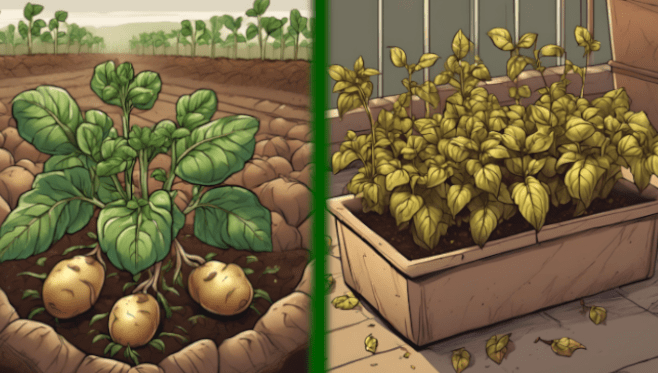
So, last year, I planted potatoes in old tires. Yes, tires. You know, those things you drive on? I figured, “Hey, this will be great!” A way to keep down on the weeds, mostly. I hate weeding. I like to tinker with things, like I said, and potatoes in tires is tinkering par excellence. As it was, it rained a lot last summer, and the potatoes didn’t exactly thrive. They were more like, potatoettes, potato bites. It was a poor growing season all around. I only got one scraggly, scrawny red beet last summer either.
Then, because I’m arguably under some circumstances insane, I planted a second round of potatoes after the first round of taters—expecting different results. And those did… absolutely nothing. Not a single spud. Zilch. Fast forward, through the winter, to the other day, and I’m looking at my tire gardens, which, by the way, I haven’t planted anything in yet. And what do I see? Two “volunteer” potato plants, two plants that cropped up (Like that? Cropped?) They’d just sprouted up, and they’re going strong by all accounts. It’s like they’re saying, “Hey, we’re here! We got this!”
I didn’t plan for this; I didn’t water them; I didn’t baby them. They just happened. And now I’m excited to see what they’ll do. It’s funny because with the basil, I was all over it—watering, sunning, maybe singing some stalwart hymns—and it just wilted. But these potatoes? They’re thriving without me even knowing!
Sometimes gardening isn’t about what we do. It just happens, despite us. It’s like trusting God to give the growth. Things happen despite us, maybe in spite of us, in spite of our tinkering. Especially the things we worry about and try to control, like that fussy basil. Sometimes, we just need to let go and watch the kingdom unfold.
So, what does it look like to focus on what’s important? It means centering our efforts on scattering the seed of God’s Word, sharing the hope within us, and living out the love of Jesus in tangible ways, in ways that embody, enflesh, give real life to what we ourselves have experienced from God. It means trusting that when we do this, God will cause the growth. It means having the courage to speak about our faith, to share our stories of God’s goodness, and to trust that even the smallest act of love can be used by God to transform lives.
It’s easy to get caught up in the trappings of church life that we forget our true mission. But we’re called to sow the seed of God’s Word generously and trust in the mystery of growth that he brings. It’s not about having the best programs, the exact number of bulletins, or a perfectly manicured lawn. It’s about being a community that embodies the love and grace of God—and being ready, willing, and courageous enough to talk about why that love matters to us, to you.
When we focus on our true mission, when we scatter the seed faithfully, we can trust that God will do his part, keep his promise to work with us. He will bring about the growth. He will cause the transformation. All things work together for good for those who love God, who are called according to his purpose—and we love God, we are called according to his purpose. Our job is to be faithful in planting and watering, and to trust in God who makes things grow.
So, it’s good for us to recommit ourselves to the work that truly matters, to scatter the seed of God’s love and grace at all times and in all places, to trust that God will bring the growth—in his time and in his way. Embrace the courage to keep doing the work of the kingdom, knowing that it’s God who brings the harvest. We need to stop tinkering with what doesn’t matter and focus on what does.
In the name of the Father and of the Son and of the Holy Spirit. Amen.
 The Rev'd Daniel W. Spigelmyer, Jr.