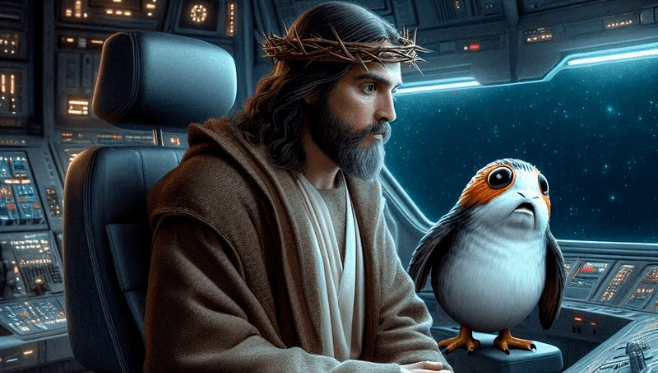
Jesus’ incarnational life was pretty remarkable. Yet of everything that happened, three seminal moments stand out: his unconventional birth, his sacrificial death and glorious resurrection, and his triumphant ascension. At his birth, he entered the world as Emanuel, God with us, bringing hope and salvation in a way we didn’t anticipate. Through his death and resurrection, he conquered sin and death, offering redemption and new life to all who believe. Finally, his ascension marked his return to heaven, where he reigns as Lord and mediator. These pivotal moments invite us to delve deeper into the significance of Jesus’ life and mission, not just as such, but for us individually and collectively who call ourselves Christians. Keep that in mind as we explore what his whole life means for us today.
Let us pray. May the words of my mouth and the meditations of our hearts be acceptable in your sight, O Lord, our rock and our redeemer. Amen.
Close your eyes and give in to your imagination. Picture it. Two men, Obi-Wan Kenobi and Darth Vader, dueling vigorously. Their lightsabers sear through the air with the iconic hum of ionized air parting for the blade of light. The lightsabers clash in a breathtaking whirl of speed and agility. And then, suddenly, Obi-Wan sacrifices himself to Darth Vader, the Dark Lord of the Sith’s lightsaber dealing a fatal blow to the Jedi Master. Anyone watching can see that he willingly lowered his defenses, allowing Vader to strike him down.
Luke, Obi-Wan’s padawan, or apprentice, if you will, sees it all. As he witnesses the loss of his mentor he begins to understand the importance of the Jedi path. Luke’s reaction to Obi-Wan’e sacrifice is deeply emotional. As he watches Obi-Wan willingly face Vader, there’s a mix of shock, disbelief, and sorrow on his face. Luke’s eyes reflect the realization that he’s losing not just a mentor, but also a father figure.
The moment Obi-Wan disappears into the Force, Luke’s expression transitions into a blend of sadness and determination. He understands that Obi-Wan’s sacrifice was not in vain. He resolves to carry on his legacy and embraces the path of the Jedi. It’s a pivotal moment in Luke’s life. He’s propelled toward his destiny as a Jedi Knight. His reaction is initially one of shock and sadness, but he ultimately channels his grief into determination, vowing to continue Obi-Wan’s mission and embrace the role he had been preparing and training for, the life of a Jedi.
Luke Skywalker of the Star Wars saga isn’t the only such apprentice who finds himself taking up the mantle, the work and legacy, of a teacher, mentor, or even inspirational parent. English teacher John Keating inspires his students to seize the day and pursue their passions. When Keating is dismissed from the school, his students carry on his legacy by embracing their individuality and standing up for what they believe in. The Dead Poets Society.
Rocky Balboa, a down-and-out boxer from Philadelphia, receives guidance and training from his mentor, Mickey Goldmill. After Mickey’s death, Rocky continues to pursue his boxing career and eventually becomes a mentor himself, training and mentoring young boxers. Rocky.
Simba loses his father, Mufasa, at a young age and is forced to flee his kingdom. Simba grows from a naive cub into a wise and courageous leader, remembering his father, and he ultimately returns to reclaim his rightful place as king of the Pride Lands. The Lion King.
Albus Dumbledore, the wise and powerful headmaster of Hogwarts School of Witchcraft and Wizardry, is killed by Severus Snape, a double agent against the infamous dark wizard, Lord Voldemort. Harry Potter, Dumbledore’s student and protege, is left to confront the dark forces threatening the wizarding world and ends up taking on the role of a mentor himself, guiding his friends and allies in the fight against evil. Harry Potter.
We could keep listing and listing examples from literature or film or theatre where a students or apprentices or children loses their teacher, mentor, or parent and finds themselves taking on that role for themselves. But today we don’t need to look to storytelling for such an example. Today we remember the Ascension of Jesus, his return to heaven to reign in glory at the right hand of God the Father—a very real event.
In a breathtaking moment atop Mount Olivet, Jesus ascends to heaven, his disciples gazing in awe. His departure magnifies his divine authority, cementing his role as mediator. It ignites hope and promises transformative change. Yet, everything he taught remains as a constant reminder of his love. The disciples stand transfixed, witnessing a moment that echoes through eternity.
Yet in the middle of all this awesome display of glory, hearkening to the whirlwind departure into heaven of Elijah from his disciple Elisha, the disciples of Jesus are likewise just left standing there. I can imagine their mouths agape, like in the old Warner Brothers cartoons. Imagine their own whirlwind of emotions as they witnessed their beloved teacher and Lord ascend into the sky. Just forty days prior, they had experienced the miracle of his resurrection from death. Now, they stand in awe and bewilderment as he vanishes from their sight. Quite literally, their teacher and Lord just ascended into the sky right out of their sight—and all that only forty days after miraculously rising to life again from death! How much more could their embedded understanding for how things are supposed to work be expected to take?! Yet, amidst their perplexity, angels speak words of reassurance and remind them of Jesus’ promise to return.
We know “for us and for our salvation,” Jesus came down from heaven. “For us and our salvation” he was incarnate of the Holy Spirit and virgin Mary. “For us and our salvation” he was baptized. “For us and our salvation” he healed the sick, welcomed the outcast, and gave new hope to the brokenhearted and poor. “For us and our salvation” he suffered under Pontius Pilate. “For us for our salvation” he was crucified, died, was buried, and descended into hell. And “for us and for our salvation” he rose again from the dead so that we who’ve been buried with him through baptism into death, might also like him be raised from the dead through the glory of the Father, and like him, come into a new life, freed from whatever separates us from God and his love. All this to say, we know that everything Jesus did, he did for us, for us and for our salvation.
And so what of the ascension?
Well, naturally, for us and our salvation Jesus ascended into heaven, and is seated at the right hand of God the Father almighty.
The ascension isn’t merely a departure but a moment of profound transition. Yes—it’s Jesus’ return to his heaven, but more importantly it marks his victory over sin and death, affirms his divine authority and sovereignty, and brings to a close his own earthly ministry. As his disciples, grappling with Jesus’ ascension impels us to reconsider our understanding of his ongoing role as mediator and advocate and our own call to discipleship, the call he spent his whole life, even beyond death and the grave, preparing us for.
Yet, before we rush headlong into what we’re supposed to do, we must cherish the most compelling truth about the ascension—Jesus’ continued identification with humanity. Despite ascending to heaven, Jesus remains intimately connected to the human experience, to us. He is fully God and fully human, after all. In his descent from heaven, he brought God to us. In his ascent to heaven, he brings us to God. This happy exchange should provide us with the uttermost solace and reassurance. We know our own struggles and challenges are understood and empathized in heaven with by the one who walked among us.
Moreover, the ascension is a true source of new hope for us. It underscores the ever available possibility for transformation and renewal. If Jesus, in his humanity, can ascend to such heights, we too, who share with him in all things, possess the potential for similar growth and change in our lives. This hope isn’t simply wishful thinking or polyannish delusion; rather, it’s in a concrete reality, the concrete reality of Jesus’ victory over sin and death, which he gives us out of his abundant and overflowing love.
Yet, alongside the hope engendered by the ascension, we are faced with a challenge—a challenge to see others through the eyes of Christ. If Jesus, in his exalted glory, enthroned in heaven, can identify with all of humanity, even those who betrayed and crucified him, then who are we to withhold empathy and compassion to those whom we find difficult or disagreeable? “The servant is not greater than the master,” Jesus reminds us in St. John’s gospel. Jesus gave us a new commandment, that we love one another as he has loved us. This is our challenge, this is our call, and it comes to rest squarely on our shoulders at the ascension. Our teacher and Lord has departed from us. Now we take up the mantle of his work and legacy as it becomes ours to carry forward—for his sake and for the sake of those he came to save, those he came to love.
Like Luke Skywalker at the sudden death of his mentor Obi-wan, Jesus’ disciples were likely initially shocked and sad when he ascended into the clouds out of sight. After all, they had just gotten him back from death, and now he’s gone again. But they, like Luke, ultimately channel their grief into determination. They continue Jesus’ mission and embrace the role he had been preparing and training them for—to make disciples of all nations and to teach everything he had commanded them, namely, to love one another.
In the same way, disciples of the disciples, we are charged, we are called to continue Jesus’ mission, to embrace the role we have been prepared and trained for—to bring others into the truth of God’s love, by not only our words but also our actions, and to welcome them as fellow disciples in the mission we share. “I will give you a new heart and put a new spirit in you,” says the prophet Ezekiel speaking on behalf of God, words Jesus fulfilled and words, not only by themselves but by virtue of our union with Jesus, that become true for us as well. “I will remove from you your heart of stone,” he goes on, “and give you a heart of flesh.”
Ezekiel speaks to the transformative power of God’s love, which has the capacity to soften even the hardest of hearts. And this is the essence of our call as disciples of Jesus, charged to carry on his work as even now he works on our behalf in heaven. Looking at others through the eyes of Christ isn’t merely an intellectual exercise but a spiritual journey toward cultivating a heart of flesh, capable of extending love and grace to all, regardless of their actions or circumstances. Through prayer, reflection, and a willingness to be transformed by God’s love, we embrace this challenge and participate in the redemptive work of Christ in the world.
Our teacher and Lord, our God, Jesus—he has returned to heaven, but we know that he returns for us, for us and for our salvation. He ascended as one who fully identifies with us in heaven because he ascended as the fully human one. In the fullness of his humanity, the fullness of God’s love is intimately identified with us, humanity with divinity. And so the ascension likewise invites us to embrace our own humanity as cherished and valued in the eyes of God, and to live with new hope and confidence knowing that Jesus is with us always. Likewise, even as we wrestle with what it all means, we know our teacher and Lord didn’t sacrifice himself in vain. He gave himself for us and the world God so loves. And so we are resolved to carry on his legacy and embrace the path of Christ—the path of love that stretches from earth, to heaven, and beyond.
In the name of the Father and of the Son and of the Holy Spirit. Amen.
 The Rev'd Daniel W. Spigelmyer, Jr.