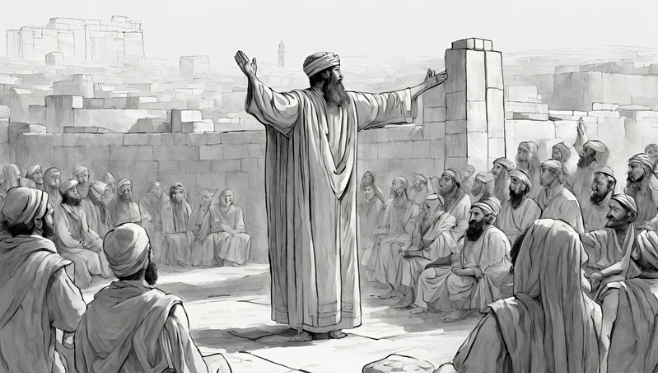
In ancient Jewish culture, prophets weren’t just guys spouting wise sayings. They were like spiritual thunderstorms, churning with the electric potential of God’s message. Picture them as human radios tuned to God’s wavelength, broadcasting God’s Word to the people.
These prophets weren’t your run-of-the-mill public speakers. What we call prophets were like ancient oracles of Delphi or the sibyls of Cumae, spilling out visions. Prophets delivered their visions in poetic verses, often singing them aloud as songs. You can even tell when you read Scripture today when the words of Ezekiel, or Isaiah, or Jeremiah were prose or poetry by the way the text is formatted in our Bible. Blocks of texts like a paragraph are just that—paragraphs. Long passages that have indentations and short phrases broken into lines—that’s the translation of ancient Hebrew poetry.
Either way, the words of the prophets weren’t just information. They were transformation. When they spoke, God’s Word acted like a double-edged sword, cutting through the fluff and getting to the core of things. God’s Word isn’t always a cozy blanket. Sometimes it’s more like a lightning bolt. It comforts the hurting and shakes up the comfortable. And prophets? They were the delivery folks for God’s message. They brought solace to the broken and shook things up for the complacent.
In this Lenten season, we especially need to tune our ears to the prophetic voices among us. Lent isn’t just about giving up chocolate or Netflix. It’s about going deeper, peeling back the layers of our hearts like peeling back the layers of an onion to confront the truth within. The prophets of old remind us that God’s Word isn’t always easy to hear, but it’s essential for our transformation. It’s essential to our repentance. It’s essential to getting our lives aligned with the design God first planned for us. As we continue through Lent, let’s open our hearts to the prophetic words that challenge, convict, and inspire us to live more fully out God’s call.
Let us pray. May only God’s Word be spoken and may only God’s Word be heard; in the name of Jesus. Amen.
“Take up your cross,” Christ Jesus said;
a call to follow where he led,
through trials, pain, and sacrifice—
in humble service, pay the price.
For in the bearing of our cross,
we find the gain outweighs the loss.
In giving all, we truly find,
the joy of hearts made pure and kind.
Discipleship demands a price;
to walk with Christ, a sacrifice—
not just mere words, but deeds we bear,
in all he gives to us to care.
Each step we take, each burden borne,
in faithful serving, not forlorn,
led by the Spirit, clear and true,
to love as Jesus loved us too.
To lose ourselves in service true,
to give our all, our lives renew;
for in our giving, we receive
and find the peace that never leaves.
To sacrifice is to align
our will with God’s, in love divine;
to give ourselves, our all, our best,
and in that giving, find our rest.
As Jesus gave, so too we give
in serving for as long as we live,
to share God’s love, to bear the load
and walk the path that Jesus trod.
So let us take our cross today
and follow Christ, without delay;
in sacrifice, in love, in prayer,
with hearts and hands, Love’s burden bear.
When the road is steep, hard, long,
and trials test our faithful song,
let us remember, in our trust,
Christ himself has gone before us.
As we journey, so let us strive,
to live the truth, to keep alive;
the call to serve—to sacrifice—
dying to self, rising to life.
We lift our eyes to heaven’s light,
and press on through the darkest night,
so that at last our journey done,
his loss our gain and victory won.
Let us take up the cross today
and walk the narrow, Christly way.
In discipled trust that never ceases,
let us ever walk with Jesus.
In the name of the Father and of the Son and of the Holy Spirit. Amen.
 The Rev'd Daniel W. Spigelmyer, Jr.