Grace and peace to you from God, our father and our Lord and Savior Jesus Christ. Amen.
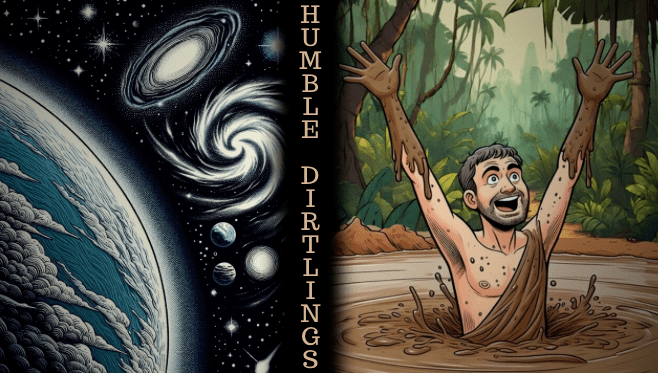
13.8 billion years ago. An infinitesimal speck, if you can even call it that, with an infinite density, lies dormant. Chaos reigns within it, small though it is. Disorder, confusion, disarray—these are compacted and rage within this invisible yet real mite. Then in an instant, a voice rings out, “hayah or,” and a silent explosion of iridescent light bursts forth, undoing the chaos, undoing the disorder, undoing the confusion, undoing the disarray—unleashing the very power of God in the newly birthed universe.
Within seconds, matter forms. Hydrogen, helium, and lithium zoom around within three seconds. Around 300,000 years after the first eruption, waves of light continue to stretch to lower and lower energy, while matter travels onward largely unaffected. Neutral atoms are formed as electrons link up with hydrogen and helium. Things start to cool down and gravity causes pockets of hydrogen, helium, and lithium to swirl about themselves. Stars likewise swirl together into galaxies. Inside these stars, pressure and temperatures mount over millions of years.
About 300 million years after the first Big Bang, say roughly 12-15 billion years ago, give or take a few million years, heavier elements like oxygen, nitrogen, carbon, calcium, and phosphorus start spewing forth from their star mothers. Fast forward to 5 billion years ago, and our own cherished earth forms as a molten ball comprising, by far, mostly oxygen, hydrogen, nitrogen, carbon, calcium, and phosphorus.
The earth raged. Gaseous compounds arose—mostly poisonous. Atmosphere formed. Water formed, and seas gathered around the base of sulfuric volcanos. Then ice covered the planet in a blanket that would make any later ice age seem a mere dusting of snow. The planet churned and roiled and convulsed. Yet at its most fundamental, the basic elements birthed at the moment of creation, forged in the cosmic furnaces of stars, come to find their humble home in the very soil beneath our feet and themselves create the solid foundation of our own existence.
In our sacred text, in Genesis, the account of creation whose very name means “beginning,” we encounter the profound imagery of God sculpting humanity from the dust of the earth, breathing life into Adam’s lungs, and infusing him with the animating spark of life. This narrative echoes the intimate bond between humanity and nature, affirming our shared origin and inherent worth as creations molded in the likeness of God.
Dirt, often overlooked as mundane, is a tangible testament to our planetary home’s cosmic roots and its intrinsic link to the whole universe. Composed of the same elemental ingredients as the celestial bodies in the night sky above us, dirt testifies to the intractable connection of matter and spirit, imprinted with God’s very own fingerprint upon our earthly home.
Humility, akin to the fertile soil nurturing life, nurtures the fertile ground of the human soul, fostering growth and renewal. It calls us to embrace our frailties and finite existence, recognizing our reliance on the sustaining grace of God. Through humility, we gain the courage to acknowledge our limitations, the wisdom to learn from our missteps, and the grace to extend compassion and forgiveness to others.
Our ancestors, long before the advent of modern technological, gadety science, understood the relationship between the earth, humanity, and humility. Take for example the Latin words “humus,” “homo,” and “humilitas”—“dirt,” “human,” and “humility,” respectively. These words share a common root, and by that very relationship we know our forebears recognized the interconnectedness of our earthly origins, our own selves, and modesty, meekness, and restraint. All this springs from dirt, the very soil God uses to form life. Here integrity and peace spring forth, reflecting our shared humanity and the humility inherent in our existence—a humility rooted in the dirt of the ground that nourishes the whole planet and came about from the very fundamental particles of creation itself. This ancient wisdom reminds us that humility isn’t a new concept, but a timeless virtue woven into the fabric of our collective consciousness.
On this first day of Lent, a journey toward Easter when we seriously consider who we are and what our lives truly are, we do well to embrace humility, to remember we are humble dirtlings. We do well to acknowledge our essential identity as dirtlings, fashioned in the image of God and animated to life by the very breath of God, by the Holy Spirit herself. Take this Lent to marvel at the awesome-yet-simple complexity of creation. Rejoice in the interconnectedness of all life and the sanctity of every person, who like you is made of the same stuff as the trees, as the seas, as the stars, as the very dirt under your feet. In humility, we uncover what it means to be truly human—beloved creations made of the stuff of dirt in the in image of God and filled with the spark of God’s own Spirit. We’re dirtlings, made of dust infused with the breath of life, who in love have been entrusted with stewardship and service in the world as God stewarded and served us in Jesus.
The soil is fertile when it’s cultivated in humility. Sow seeds of compassion, kindness, and justice. Nurture the blossoms of God’s creation. In gentle humility, we find both solace and fortitude by placing our trust in the boundless love and wisdom of the God, the creator who shaped us from the dust of the ground and breathed into us the gift of life. God leads us faithfully as we tread humbly upon the earth, whose own essence we share. By our lives, we illuminate the transformative potency of love, grace, and humility and point to the one whose own life lead the path toward wholeness, harmony, and divine communion with us and all creation—Jesus Christ our Lord.
In the name of the Father and of the Son and of the Holy Spirit. Amen.
 The Rev'd Daniel W. Spigelmyer, Jr.