Baptism is a sacrament. What does that mean? A sacrament is a practice, handed down by Jesus, where God’s grace is uniquely revealed and conveyed to believers—a means of grace. In the case of baptism, God’s mercy and love are made ours through God’s Word and physical water. It’s a not merely a spiritual rebirth, but an actual rebirth, and what’s more, the welcome into the Christian community. Baptism, thus, in that sense, embodies the incarnational promise of Jesus in two ways—it makes real the promise of God, the Word made flesh, the same as how Jesus made real the promise of God, the Word made flesh, through his own incarnation at Christmas, as well as incarnates yet again the body of Christ in our lives today, yet this time through us, the living members of Jesus, his hands and feet, eyes and ears, his very heart in today’s world and for the sake of the world.
Like all sacraments, baptism reminds us that God’s grace is freely given, irrespective of our worthiness, and drives home the promise of God’s transformative, powerful love. Baptism isn’t merely a human action; it’s a divine mystery, an unveiling or revelation of God where grace becomes truly real in the lives of believers. Keep this in mind today as we go forward, and carry it with you as you live your lives day to day as baptized disciples of Jesus.
Let us pray. May the words of my mouth and the meditations of our hearts be acceptable in your sight, O Lord, our Rock and our Redeemer. Amen.
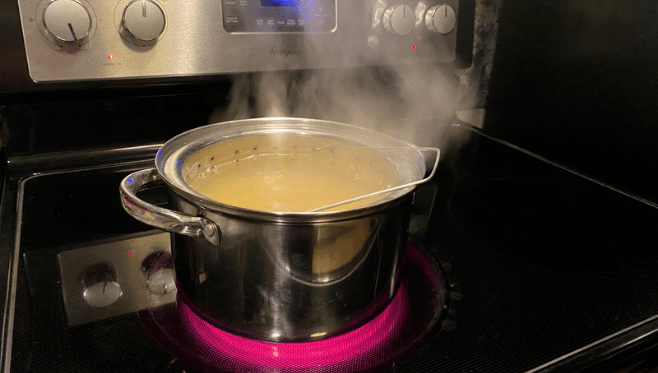
Matteo burst into the kitchen one afternoon after school. His father, startled, nearly dropped the cup of coffee he was drinking at the sound of the door flying open and the sound of the backpack clamoring to the floor. “My! You make a lot of noise. And you’re later than usual getting home. What was the hold up?” said his father, taking a sip of his coffee and laying the Sentinel & Enterprise down on the table. “I stopped at the church on the way home to help Pastor. He was setting up for the baptism this week. I helped him make the holy water.” His father, a bit skeptical of all the ritual and pomp and circumstance their new pastor seemed in love with, asked Matteo, “And how exactly is it that one makes holy water?” Matteo, studying the contents of the fridge without even looking at his father, says, “It’s really easy. You just put it in a pot and boil the hell out of it.”
All joking aside, baptism isn’t a laughing matter. To be sure, it’s a joyful thing, something to get excited about, but it’s no laughing matter. We have every reason to celebrate at the baptism of someone, for as St. Paul reminds us today, through a biblical Q&A, “Do you not know that all of us who have been baptized into Christ Jesus were baptized into his death? Therefore, we have been buried with him by baptism into death, so that, just as Christ was raised from the dead by the glory of the Father, so we too might walk in newness of life.” Baptism is a rebirth from sin to life. We often will think of this as a “get out of hell free” card, but while that’s somewhat true—well, in fact, wholly true—it’s not what’s really so fantastic about baptism. Nor is it what makes baptism no laughing matter. Yes—baptism imputes the forgiveness of sins, but what does that mean? It means to be born again—to get reoriented, realigned, readjusted, restored to the design God has for us as part of his wider creation.
Baptism is about repentance.
Not so much a repentance that beats ourselves up and bemoans what rotten sinners we are, but rather repentance that acknowledges what our lives are really like, good and bad, and seeks God’s mercy and grace to fill us and our whole lives so that whatever’s bad can be transformed to good and what’s already good can be appreciated for the bounteous gift that it is. Repentance in this sense isn’t so much wallowing about because of our inherent wickedness, but instead an acceptance of our need, an acceptance of our blessing, an acceptance of God’s abundant mercy, and an acceptance that without that mercy, neither our need nor our blessing will be met.
Repentance, in the Christian sense, rejects the notion that we make our own path, that we are responsible for our own success, that by our own good living, our own good thoughts and deeds, we will please God and stave off difficulty and ultimately even God’s wrath. Repentance, in the Christian sense, accepts, acknowledges, and admits that we, that I can’t do it alone, but because of God’s mercy, I am forgiven—that is, I am freed from worrying about going to hell, freed from worrying about if I’m good enough to please God, freed from worrying if I’m living a good enough life or keeping from doing enough bad things. Repentance, in the Christian sense, means to reject the ways of sin that promise peace of mind, happiness, satisfaction, and friendship, but lead only to an acrid accumulation of mental and emotional garbage, frenzied and joyless grabs for happiness, all-consuming-yet-never-satisfied wants, and a spiteful obsession with degrading everyone into an opponent. Repentance, in the Christian sense, means to reject the ways of popular wisdom that rebel against God—draw us away from leading lives of humility before others into a rat race that puts ourselves and our own needs forever and always before the needs of others. Repentance, in the Christian sense, means to reject the lies, the deceptions, and the wiles of the devil—who would go so far to tell you he doesn’t exist, to lull you into easily believing his most crafty lie of all, that you are not God’s child, his beloved, with whom he is well pleased.
Repentance rejects all these things, embraces the truth of God, and aligns with God’s love for you and for all things. Baptism is repentance from everything and anything that takes the fullness of life away from you, and instead embraces a newness of life that runs counter to popular wisdom—and instead aligns with God’s wisdom, however foolish that may look in the eyes of the world.
And while it might be easy to think that since baptism is an event that is once and done—for we believe in one baptism for the forgiveness of sins, once and for all restored to good relationship with God—the repentance of baptism is something that we must daily embrace. In fact, a life of daily repentance as a baptized disciple of Jesus can be likened to a life lived in hot water in several ways. Repentance reshapes our minds, reshapes our lives—conforms our minds and our lives to the mind and life of Jesus, and so just as someone immersed in hot water experiences a constant awareness of the temperature, a baptized disciple lives with a heightened sensitivity to their actions and attitudes.
Repentance becomes a regular practice, akin to adjusting to the warmth or heat of the water.
You might say that the baptized life, life as a disciple of Jesus is a life lived in hot water—and that, folks, is no laughing matter.
But what does that mean, exactly? Put another way, a life faithful to God’s call is no laughing matter, not always something easy.
Take Noah, known for his faithfulness, and whose harrowing passage in the ark St. Peter tells us foreshadows the gift of baptism. “In the days of Noah,” Peter tells us, “a few, that is, eight persons, were saved through water. And baptism, which this prefigured, now saves you—not as a removal of dirt from the body, but as an appeal to God for a good conscience, through the resurrection of Jesus Christ.” Today’s lesson about Noah shows us how a life of faithfulness is a life lived in hot water.
Noah faced skepticism and opposition from those who doubted the impending flood. Despite this, his faithfulness to God’s instructions led him to build the ark. Noah was in hot water with those around him. The floodwaters not only symbolize trouble and adversity, but how often do trouble and adversity seem to overwhelm us to the point of drowning in worry, anxiety, and hopelessness? Not mere symbols, but reality itself! The ark, constructed through faith, built because of Noah’s relationship with God, is a vessel of safety amid turbulent waters. The ark, as the relationship Noah had with God, provided the endurance required in a life of faithfulness amid the chaos. And the journey, the long span of time chronicled in the story—that’s the uncertainty, the churning of boiling water. The flood submerged the familiar and carried Noah into uncharted territory. In the same way, faithful disciples encounter unknown challenges in our commitment to God. While in the ark, Noah remained steadfast in his trust in God. Likewise, when hot water surrounds us, unwavering faith, our assurance in God’s commitment to his relationship with us, becomes our anchor, and that allows us to rest secure in his promise so that we can weather storms of doubt and difficulty. And finally, the receding floodwaters mark a new beginning for Noah and his family. In like manner, the hot water we experience as disciples of Jesus leads to transformative growth and the emergence of a renewed spiritual life. Hot water cleanses, and so too the process of daily repentance allows us disciples to be cleansed spiritually. It involves acknowledging mistakes, seeking God’s mercy, and striving for a renewed and purified life. Either way, there’s a cleansing and renewal that come with being in hot water, whether literally or metaphorically. We see in Noah how a life of faithfulness is a life lived in hot water—with all its comforts and all its challenges.
It might seem that a life lived in hot water isn’t all that great, and definitely not something that we’d want to go through, let alone embrace. But consider it a different way. How many of you enjoy a nice hot bath, to unwind, relax, and regroup? I know I do. It’s one of life’s little luxuries, I say. I love to take a hot, hot bath, with bath bombs and lie there and allow the hot water to cover me over. Sometimes the water is so hot when I get in, I initially want to jump back out of the tub—but I don’t. I know it’s going to be nice, and so I choose to not only to stay standing in the water, but to get all the way into the tub, to put my whole body in the hot water!
Just like the warmth of hot water evelopes and touches every part of our body in a hot, hot bath and helps us unwind, relax, and regroup, daily repentance reaches into the depths of a disciple’s soul, into the depths of your soul, and fills you with the warming love of God that removes nagging doubt and worry and conniving bitterness and rivalry for the all-pervasive holiness of the Holy Spirit and, at the end of the day, a closer relationship with God. Just as staying in hot water requires a intentional choice, a life of daily repentance involves intentional decisions to turn away from whatever it is that doesn’t align with God’s good design for life and align yourself with the model of the godly life given us in Jesus. It’s a continual process of reorientation, realignment, readjustment, and restoration.
Daily repentance purges impurities and reminds us of God’s cleansing grace poured out in baptism. Daily repentance revitalizes, invigorates, and brings spiritual renewal, refreshing our connection with God, and rejuvenating our commitment to Christly living. Daily repentance is a catalyst for spiritual change, molding us disciple into vessels capable of holding and reflecting the grace of God. Daily repentance involves a deliberate commitment to spiritual immersion.
It’s an intentional choice to remain submerged in the teachings of Jesus where we conform our lives to his guidance and wisdom. As baptized disciples, we submerge ourselves in the hot water of daily repentance, not because it’s easy, but because God promises us that with perseverance and challenges, we absorb more and more of the holiness that marks a life lived aligned with God’s purpose for us in Christ Jesus. A life of repentance, a life lived in the hot water of discipleship, a life born again through water and Spirit—that’s a life lived with God with the commitment from him to emerge purified, renewed, and transformed each and every day.
In the name in which we are baptized: Father, + Son, and Holy Spirit. Amen.
 The Rev'd Daniel W. Spigelmyer, Jr.