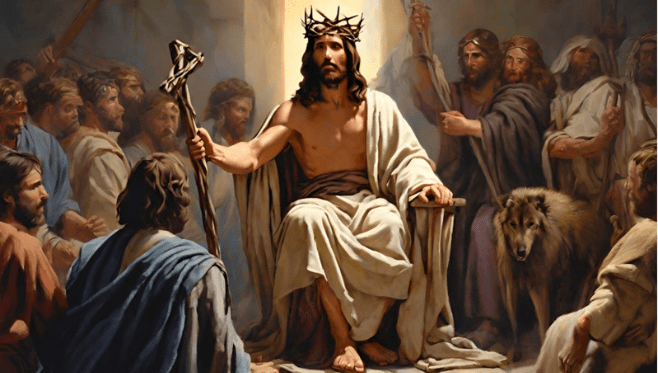
Like so much in our lives, today’s feast day, Christ the King, or the Reign of Christ, or Christ the Sovereign of Time—whichever title you choose to use—this day highlights an interesting paradox. In the contrast between the grandeur of Christ the King and the simplicity of Christ the humble servant, a profound tension emerges. Jesus of course, is both these things—king and servant—at the same time. His glory radiates through divine majesty, yet it harmonizes with an earthly humility that defies expectation. And these together, he tells us, create true glory.
This juxtaposition challenges us to embrace both facets, fostering a deeper understanding of spirituality and ultimately our relationship with God, one another, and all creation. As we reflect on this paradox, let it inspire a humble walk in our own day-to-day lives, embodying both strength and compassion in the service of others, following the example set by the ruler of our lives, Christ the king.
Let us pray. May on God’s Word be spoken and may only God’s Word be heard; in the name of Jesus. Amen.
This past spring, on May 6, 2023, some 20.4 million people the world over watched as one man was anointed with holy oil, invested with regnal robes and other regalia, and a crown placed upon his head. On that day, Charles III was crowned King of the United Kingdom and Other Commonwealth Realms—fourteen commonwealth realms to be exact. 20.4 million. For comparison, there’s 6.9 million people in all of Massachusetts. That’s almost three times the population of the whole state of Massachusetts who tuned in, from around the world, to watch one man become king.
In addition to being the king, the head of state, Charles is also styled “Defender of the Faith,” and is the head of the Church of England. This is largely a ceremonial role today, much like his position as the king isn’t much of a governing one. Under Britain’s constitution, the monarch isn’t the head of government; they’re the head of state. The head of government is the prime minister, an elected position. For you political junkies, Rishi Sunak is the Prime Minister of the United Kingdom right now, but I digress. In addition to being king, Charles is “Defender of the Faith” and head of the Church of England.
To us, this might seem strange, but the idea that monarchs are vested with both secular and sacred authority isn’t anything new. In fact, it’s a very old idea. There’s even a name of the idea—the Divine Right of Kings. This idea holds that monarchs derive their authority from God, not from their subjects, and as such rebellion or insurrection are the worst of political crimes, since they defy the will of God.
The notion that kings and queens are divinely appointed stretches back to antiquity. And even goes so far as many rulers being considered divine themselves. Take the pharaohs of Egypt. They were seen as the earthly embodiment of Horus, the god of healing, protection, the sun and the sky, and lastly, kingship. The Egyptians weren’t alone, though, in seeing their kings as embodiments of the gods. The idea is very prevalent. Emperors of China and of Japan, of the Inca and of the Aztecs, of Rome. This notion that the kings were God’s embodiment is sometimes also spoken of as the imprint of God, or the image of God. That is to say, kings not only represented God’s authority, both secular and sacred, but they themselves were marked with it and by their very own selves, were gods.
That wasn’t the case for the ancient Hebrews, however. They held a vastly different view of kingly authority, at least as far as the king’s identity went. (In fact, kingship for the Israelites derived its authority from shepherding, interesting tidbit.) To be sure, when the Israelites demanded a king, Samuel anointed Saul, and later David, and those who came after, were both secular and sacred rulers, or shepherds over the kingdom, but Saul and David, Solomon and Josiah, and all the rest of the kings of Israel—they were not seen as the imprint of God, or the image of God. They were not the embodiment of God on earth. In fact, the idea that God could be reduced to a single human, with a single appearance, was blasphemous. It violated the very fundamental law of God—“You shall not make for yourself a likeness of God, whether in the form of anything that is in heaven above, or that is on the earth beneath, or that is in the water under the earth.” Behind this commandment, which we all know well, is the notion that God cannot be depicted. Further, the created, that is, we cannot ourselves create the creator…The finite cannot create the infinite…
It’s the very essence of God to be uncontained. When Moses asks his name, God simply responds that he is. “I am who I am and I will be who I will be.” There’s a whole host or reasons for such a way of thinking of God, worthy of further reflection, but suffice it for us today that God’s particular appearance is one that, for the ancient Hebrews and Israelites, and for Jews to this day, can’t be contained in a single person. And so God will not be reduced to an avatar, to a manifestation in bodily form on earth.
But there’s more to it than simply God isn’t embodied in the king when we think of the different notion of kingship for the Israelites—and for us, for that matter. After all, the Israelites are our forebears in the faith, and much of our foundational faith has its grounding in Judaism. Perhaps more important than saying God’s appearance can’t be contained in the king, in one person, is the fact that when God created humanity, he created us all in his image. It’s not just the king who’s the image of God. It’s each and every person who’s ever been created. God’s image is not about an appearance, but about who God is—and what God does.
“I am who I am, and I will be who I will be.” This notion encompasses so much, including the multiplicity of human identities—male and female and everything in between, different races, languages, ages, mental and physical abilities. Each and every person is created in the image of God, and what’s more, has been given dominion over the earth. Dominion—a word associated with ruling, with governing, with kingship. God has created each and every one us, in his image, in the image of God, and given us power and authority over creation. Not just the king, but all of us. We are all monarchs. We are all kings.
So what does this mean? It means that since we’ve been given divine power and authority to rule, it means that since we are created in the image of God, we use our power and authority to rule the way that God rules. We are the image of God, after all. And how does God choose to rule? God tends a garden and places us in it. It would seem that gardening is what using our power and authority in God’s image is about. We rule the creation of God by cultivating it—taking care of it, stewarding it, helping it thrive.
As part of this, we take care of each other. Of course, taken literally, gardening means providing food for each other, but it also means more. It means we harness the possibility of creation, and make something more of it. We take creation somewhere. We grow families that become communities, where people have different tasks as God calls us for the good of each other. Ruling in the image of God is the day-to-day life we lead in devotion to the particular call God has given us—in devotion to loving others and in so doing, loving God made human in faces of other people.
God gives us a choice. We can use our power and authority the way that God designed for the good of all, good as God defines it. Or we can redefine good on our own terms, and use our authority and power for ourselves. That’s sin. We of course seek to harness the possibility of creation and make something more of it, and sometimes we do amazing things for the good of the world, but other times, oftentimes, we do terrible things, despite our best intentions, and sometimes we give rise to horrible injustice at the expense of others for our own gain—even intentionally seeking to harm others. Instead of ruling in the image of God, we rule in our own image, with our own agenda, for our own profit. We give evil, the opposite of God’s goodness, opportunity to flourish. We are middling monarchs at best—stuck between ruling in the image of God and in our own image.
Yet God’s will prevails. God himself, ruler of the universe, of all time itself, chooses—makes a choice, yet again—to use his own power and authority for good. And God chooses, God makes a choice, to be reduced to one man, anointed with the Holy Spirit and a crown of thorns placed upon his head. God chooses to give up infinity and becomes finite.
God chooses to become embodied in Jesus, who showed us what it means to rule as a human being made in the image of God. Jesus ruled by serving—not for himself, but for the sake of others, for our sake. He put himself underneath others, even those despised by the world, and loved not just his friends, but his enemies. Jesus puts himself so far underneath others that he takes on all the evil choices people, that we make for ourselves, and he bears the consequences. He lets it literally kill him—for our sake. His greatest act as king was giving his life for the good of others, for our good.
Jesus embodies not only God among us, but he embodies humanity—true humanity, humanity made in the image of God. From this humility, from this love and care for something beyond ourselves, the glory of God comes forth, full of possibility for something even greater. That’s resurrection—the defeat of death and evil for the victory of life and goodness. Jesus shows us that together, our own image and the image of God work the wonder of God’s creation even here among us now. That’s why we call Jesus the image of God and the new humanity. He reembodies God’s first creation of humanity and makes us new creations along with him, anointed like him with the Holy Spirit to rule, to care for, to steward, to serve each other and everything God’s created.
This one man, Jesus Christ our Lord, who bore the crown of thorns and died for our sake, is our king—the one who with infinite power and authority chooses not to use it for himself, but willingly in servitude to everything beneath him—this one man shows us what it means to be truly human made in the image of God. He shows us that we are truly human made in the image of God when we use our power and authority, when we harness our possibility in our day-to-day lives for the good of all things, for each other and everything God has made. Our king, Jesus Christ, from the throne of his cross, ruled the world with this same power and authority, and from that throne, the defeated death itself.
And so Jesus calls us, made in the image of God, and wearing the crown of his own name, Christian, to likewise rule with his own power and authority, not for our benefit, but as kings and queens ourselves, who like our own king, embody peace, patience, kindness, generosity, faithfulness, and most of all, love—true, sacrificial, devoted love that bears all things and doesn’t insist on its own way, trusts God always, always looks for the best, never looks back, and keeps going to the end. God has created us in his image. God who is love created us, in the image of love he created us—created us, each and every one of us, kings to rule with his love.
And Jesus, God come down from heaven, love come down from heaven, is our own king. Jesus is the King of kings.
In the name of the Father and of the Son and of the Holy Spirit. Amen.
 The Rev'd Daniel W. Spigelmyer, Jr.