Early Christians believed in the imminent return of Jesus and the end of the world, anticipating divine judgment and the victorious culmination of God’s will for all things. Many expected these events within their lifetimes. Over centuries, interpretations evolved, and expectations waned—but not everywhere for everyone. We still rightly look for the coming of Jesus any day, any moment—even now. Christians, despite over 2000 years of waiting, maintain our anticipation for Jesus’ imminent return because of our steadfast trust in God’s promises—promises that never once have been be broken from the time of Noah to the Resurrection of Jesus and into our very own day-to-day lives. Our belief is eternal in perspective, and our conviction that God’s timing is perfect, as the Psalmist reminds us today, “a thousand years in your sight are like yesterday when it is past.”
Though we face troubles now, we know that troubles develop passionate patience in us, that patience hardens our resolve, that resolve builds up hope, and that hope doesn’t disappoint. It’s this enduring hope that sustains our expectation and conforms our worldview, our spiritual outlook, and ultimately our mind to the mind of Christ. And so, keep that hope in mind as we go forward today, and every day—a hope expectant that Jesus return will happen at any moment, to bring about the promised conclusion and assured beginning of God’s will for us and for all things.
Let us pray. May the Words of my mouth and the meditations of our hearts be acceptable in your sight, O Lord, our Rock and our Redeemer. Amen.
A pastor is working in the sacristy when he hears a noise in the sanctuary, so of course, he goes out to see what it’s all about. He sees a young man, sitting in the back row in front of the choir loft. The man is downtrodden, shabby-looking, and obviously in distress. So of course, the pastor goes up to him to see if there’s anything he can do to provide care. “Hello,” he says, and without beating around the bush, he jumps right in. “What’s troubling you?” The man, doesn’t look up, but says, “I’m at my wit’s end. I got fired, the bills are piling up, and my credit cards are maxed out. I’m about to lose everything. I don’t know what to do! It’s literally like the end of the world is happening all around me!” The pastor, having compassion on the man, says to him, “That’s a lot, however, know this: all shall be well in the fullness of time. Why don’t you go to a nice, quiet park, where you can be at one with nature. Take a Bible with you, and holding it, contemplate your trials and tribulations. When you feel it’s the right moment, hold it up and wait for the wind to flip the pages open. Read what it says there, and you shall find your inspiration.”
And so, the man leaves, and the pastor doesn’t think much more about him. Some time later, on a Sunday morning as worshippers are leaving, the pastor is shaking hands on the steps of the church. The young man pulls up driving a new Porsche, wearing an expensive Italian designer suit, obviously on top of the world. “My goodness,” the pastor calls to him, “you’ve certainly turned your life around!” “Yes,” the man says, “and I owe it all to you! I did what you said. When I looked at my Bible, I knew I had found the answer!” The pastor has a momentary flash of pastoral pride, and says, “That’s wonderful! But if I may ask, what was it that you read?” The man calls back, “Chapter 13.”
All joking aside, the end of the world, as this man said, also called the Day of the Lord, the Day of Judgement, Dies Iræ—whatever you want to call it, it’s serious stuff. People get pretty caught up in it. There’s always some sort of doomsday prophet out there who’s got it calculated when the next end of the world is about to happen—despite St. Paul’s words today to the Thessalonians, and to us, where he says, “the day of the Lord will come like a thief in the night,” and “for that day to surprise you like a thief.” Jesus himself says in St. Matthew’s gospel, “about that day and hour no one knows, neither the angels of heaven, nor the Son, but only the Father.” Not even Jesus knows when he’s coming back. “You also must be ready,” he says, “for the Son of Man is coming at an unexpected hour.”
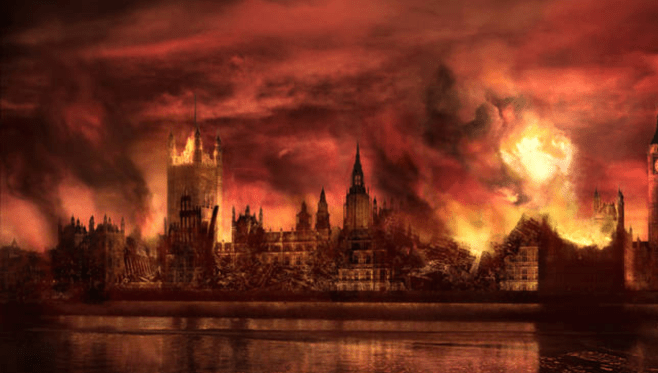
Nonetheless, it’s serious stuff. Take for instance today the prophecy from Zephaniah. He doesn’t paint a pretty picture of what the end of the world as we know it will look like. Wealth will be plundered, houses laid waste. Vineyards will be planted, but they’ll never reap a harvest. Judgement Day, the Day of Jesus’ return, that day will be a day of wrath, a day of distress and anguish, a day of ruin and devastation, a day of darkness and gloom, a day of clouds and thick darkness, a day of trumpet blast and battle cry. People will walk like the blind. Their blood will be poured out like dust, and their flesh like dung. No—Zephaniah doesn’t foretell a zip-a-dee-doo-dah, happy day. In fact, he predicts a full, a terrible end to the world where the whole earth is consumed in the fire of God’s passion. It’s no joking matter, not at all. It’s serious, serious stuff.
People fear the end of the world, and I suppose, to a degree, given what Zephaniah tells us today, it’s no wonder. Couple that with the ideas people get from reading St. John’s apocalypse—misguided and misinformed ideas, I might add—Judgement Day at face value doesn’t sound like something pleasant and nice. And rightly so. These things will happen because, as Zephaniah again tells us, the people, we have sinned against the Lord. Not a pleasant or nice thing, to be sure. As much as sin is a condition that isn’t what God wants for us, as much as we’re victims of sinfulness foisted upon us, circumstances that aren’t our fault or our doing, each and every one also commits sin. We sin are sinners.
We sin by our own fault, our own fault, our own most grievous fault. We don’t feed the hungry as we ought. We don’t quench the thirst of the thirsty as we ought. We don’t care for the downtrodden and homeless as we ought. We don’t clothe the shivering as we ought. We don’t care for the sick as we ought. We don’t comfort the mourning as we ought. We don’t rejoice with the joyful as we ought. We don’t visit the lonely or the imprisoned as we ought. Put simply, when put to the test of answering the question, as the prophet Micah asks, “What does the Lord require?”—we do not do justice, we do not love kindness, we do not walk humbly with God as we ought. Much of this world’s sinfulness, to be sure, isn’t our own fault, but we, each and every one of us—particularly in our place in this prosperous country, in this state of Massachusetts—each of us contributes more than enough of our own sinfulness to the world’s corruption, either actively or passively, to merit the destruction that Zephaniah lays before us. So, yes—if left up to ourselves, left to rely on ourselves come that day, we have every reason to dread the end of the world as we know it.
But is the end of the world as we know it really that bad? Is the end of the way this world keeps chugging along really that terrible? I suppose if you’re in the dark about the way things truly are, then yes. The end of the world as we know it is a bad thing. I suppose if you’re drunk on the envious, lustful, gluttonous, lazy, greedy, spiteful, proud lies promised by popular wisdom, then yes. The end of the world as we know it is a terrible thing. But we aren’t in darkness. We belong to the day, live in the light of Christ, and so we are sober—sober, not intoxicated on lies doused on us from every angle, but sober because we drink from the fountain of truth. We drink from Jesus, the very water of life himself, and because we do, the truth becomes in us a spring of water gushing up to eternal life.
The Day of Jesus’ return brings an end to the world as we know it—and ushers in a new thing, a new beginning, a new creation. The Day of Judgement means an end to this world’s moral and ethical bankruptcy. It means an end to racism and every other distain for difference among people, whether based on their sex, their heritage, their language, or their physical or mental abilities. It means an end to saying someone is too young and inexperienced to be wise, or too old and weak to be useful. It means an end to war. It means an end to fear, hatred, and dislike toward those for whom they love, or how they express their identity. It means an end to people without warm shelter in the winter and cool accommodation in the summer. It means an end to starving children, women, and men in some parts of the world while others pine over not having the latest gizmo or gadget in order to keep going on despairingly judging themselves inadequate in comparison to others who themselves only present their best side for the world to see.
The coming of Jesus means the verdict comes down on these things, and so much more. The coming of Jesus will be a Day of Judgement. Yes—for us, but not only for us, but also for the whole world—and more importantly for the ways of the world that draw us and all people from the fullness of life that God intends for creation. That verdict is a foregone conclusion. We know it already. Sin, death, and hell are already defeated. But on that day, the thief who robs us of life, the very devil himself, the Prince of this World and the Purveyor of Lies—he and all his ways will be judged without impunity and his defeat will be shown in full daylight that even he cannot deny the truth.
On that day, only goodness will remain. On that day, only love will remain. On that day, only life will remain. On that day, only truth will remain. And we, we who belong to God in Christ Jesus—we belong to goodness. We belong to love. We belong to life. We belong to truth. On that day, on Judgement Day, that Day of Wrath, that Dies Iræ, that day the world as we know it comes to an end—on that day of Jesus’ coming, we will be purged of our sinfulness by the fire of God’s judgement. The wrongs of our life may well flash before our eyes, but the mercy of God in Christ Jesus our Lord will be our judgement—not on account of our doing, but on account of God’s doing. On account of God’s loving compassion for all things good, all things love, all things life, all things truth.
The end of the world as we know is no joking matter. It’s serious, serious stuff. It’s the work of God fulfilling his promise to us and to all creation to make all things new for the sake of Jesus, who in his own life, death, and resurrection fulfilled for us the perfect will and the invincible love of God. We who belong to God in Christ Jesus needn’t dread that day, but can look forward with expectant hope that once and for all, the will of God will be done—and we are destined, we are promised to be part of that glorious new day, when the new light fills everything and all things such that the shadow of doubt or deception is no more, and the light of God’s goodness once more emblazons all creation.
And so, with all the faithful Christians down through the ages, say with me, Amen. Come, Lord Jesus.
In the name of the Father and of the Son and of the Holy Spirit. Amen.
 The Rev'd Daniel W. Spigelmyer, Jr.