Let be me straight with you for a moment. This isn’t one of my favorite parables from Jesus. At face value, depending on how you read it, it doesn’t seem to paint those who tend the vineyard very well, and most of the time, we’re supposed to read ourselves as the ones in Jesus’ parables as doing the work, the work of the kingdom. This parable after all talks of the kingdom of God, so it’s natural for us to see ourselves as the tenants. I don’t like how we look. Or better stated, who we are in this parable. We’re murderers!
But one thing that I’ve found in encountering the Scriptures, and Jesus’ teachings in the Scriptures, is that those places that give you the most difficulty are the ones that you should wrestle with the most. So even if this isn’t a pleasant parable, it’s important that we deal with it. It holds an important teaching for us, and perhaps one that at face value isn’t what we think it is. Keep that in mind as we go forward today…The Scriptures sometimes are difficult for us, but they always reveal God’s love for us, particularly when we deal with them honestly and earnestly. The more we wrestle with them, the deeper our understanding of God’s love for us in Jesus, and the more fruitful our relationship with him.
Let us pray. May only God’s Word be spoken, and may only God’s Word be heard; in the name of Jesus. Amen.
On Friday night, I installed a new plug in my bedroom. It’s a smart plug—courtesy of Simon. Now, a smart plug is a kind of device you plug into an outlet and then you plug something into this device. When the smart plugged is turned on, it connects to your Alexa via whatever magical forces are out there making the wifi work. So I set up this smart plug, and connected my bedside light to it. It took a bit of tinkering and troubleshooting to get the wifi connection right, but I eventually got it. It’s a nifty new toy. Now when I walk into my bedroom, I don’t have to walk all the way around the bed to turn on the light. I can just say, “Alexa, turn on the light,” and the light turns on. When I’m ready to go to sleep, even though I could roll over and just turn the knob, I now can lazily say, “Alexa, turn off the light,” and the light goes out. Like I said, it’s a nifty new toy. Thanks, Simon! It’s almost like you’re reinforcing my God complex. Now I can say, “let there be light,” and there’s light!
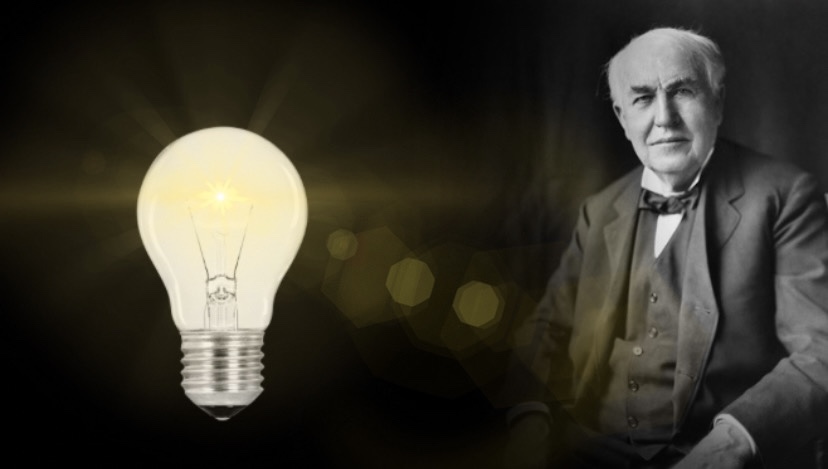
The smart plug made me think about light, more particularly lightbulbs. In the grand scheme of human history, we haven’t had lightbulbs for a long time. The electric lightbulb was invented in 1879 by Thomas Edison. We’d known about electricity for a long time before that. There is evidence in fact that we’ve known about it as far back as ancient Egypt. They made batteries, in fact. Did you know the word “electricity” comes from the Greek word ηλεκτρον, which means “amber?” Curious, right? Well, the Greeks realized when you rubbed amber, it caused a strange sort of reaction, which we today would call electrostatic. This all goes to show that Benjamin Franklin didn’t discover electricity; we’ve known about electricity for millennia. It just wasn’t until rather recently that we started investigating just exactly what it could do.
Thomas Edison was one who worked a lot at harnessing the power of electricity. His invention of the lightbulb was one such way that he did that, and perhaps the reason that he’s so renowned the world over. But there’s more to the story of the invention of the lightbulb than some white-haired man in a lab tinkering with some wire filaments and glass til he got it right. In fact, Edison didn’t work alone. He had a team of people working with him, or perhaps for him, as he tinkered with the light bulb. It’s been said that it took Edison’s team for 24 hours just to put the first lightbulb together. Once the team had finally finished with that one, first bulb, Edison handed it over to a young boy to carry upstairs. Timidly, afraid that he might drop this delicate piece of work, the boy carried it up the stairs.
I don’t have to tell you what happened. The boy dropped the bulb at the top of the stairs. So the team had to go back, take another 24 hours, and make a new bulb. Finally, the second bulb was ready to be taken upstairs like the first. And know you know what Edison did? He gave it to the same boy who dropped the first one. I don’t know what you think about it, but that’s true forgiveness. Thomas Edison gave that boy another chance…
Second chances…forgiveness…Things we all want for ourselves, but are often stingy in giving out. Look at today’s gospel. Jesus tells a parable about a vineyard planted by a landowner who leases it to tenants to care for. We don’t know much about the tenants, but we do know that when the landowner wanted to collect on the harvest, the tenants killed the slaves he sent—not only once, but twice.
So the landowner sends his son, thinking the tenants would respect his son, but they don’t. They kill him too—thinking they’ll get the inheritance, likely the vineyard. We might be tempted to think who would give over an inheritance to someone who kills their child, but the tenants may well have thought since the son came, the landowner was dead, and with the son out of the way, the vineyard would be theirs, free and clear. Why else would the landowner have sent his son if he wasn’t already dead?
And when Jesus asks what the landowner will do when he does finally come, after the tenants have killed many of his slaves and his very own son, the people answered, “He will put those wretches to a miserable death!” That does seem fair to us, doesn’t it? An eye for an eye, after all…They killed his slaves and his son, to boot.
Yet Jesus reveals the hard-heartedness of the people when he replies to their answer. Without saying it, he reveals the way we all behave, and just how incompatible it is with God’s kingdom. Remember, this is a parable, so it’s meant to teach us something about ourselves and about God, and more importantly, our relationship with God—that is, what life in the kingdom of God looks like for us.
This parable is meant to be a lightbulb moment for us…God speaks, and the light of understanding turns on in our minds. We come to understand more deeply God’s love for us in Jesus when we hear this parable.This parable is about God’s relationship with his chosen people through the ages, and what’s more, his relationship with us. Down through history, since God first said “let their be light” and there was light, God has sought a relationship with us, first with Adam and Eve in the garden, and then onward. God has spoken to us time and time again, and time and time again, we don’t believe God. This is our humanity, our weakness, our inability to fully comprehend just how magnificent, how glorious, how holy God is. We simply cannot fathom that we, creatures made of dirt, are made in the image of God and so therefore we don’t act like God acts. And yet God continually has spoken to us since the very beginning of time to remind us of our special nature, how we are made in his image, how we are loved beyond measure.
Yet the lightbulb of understanding never seemed to really quite turn on right. The connection wasn’t quite right. God sent Noah, Moses, Miriam, David to remind us of our special relationship with him. Yet we didn’t heed that completely. The lightbulb still wasn’t working. And so God sent others, the prophets—Isaiah, Jeremiah, Amos, Ezekiel and others—to tell us of his love for us and to call us to repent, to return God, to be faithful to the promise as God is faithful, but we didn’t listen. “Our ancestors acted presumptuously and stiffened their necks,” the prophet Nehemiah declares, “and did not obey God’s commandments. They refused to obey and were not mindful of the wonders performed among them.” Once again, when God spoke, the lightbulb didn’t turn on for us the way it was supposed to. That’s the story of God’s people from the dawn of time, all the way from Adam and Eve in the garden. Sometimes we even did kill God’s messengers. “Jerusalem! Jerusalem!” Jesus cries, “the city who kills prophets and stones those who are sent to her.”
Yet God didn’t stop. Finally, he sent his own Son, full of grace and truth. A light to shine in the darkness, to be the life of the world. Yet that light we didn’t like. We didn’t like what it revealed—what it revealed about us, and what it revealed about God. But this light finally made the connection. The lightbulb turned on with Jesus, and we could see—even if we didn’t like what we saw. That light revealed to us that we can’t do everything on our own. We are limited and in need of each other, in relationship—just as we are in need of God, in relationship. We don’t like that because we believe we know right. We understand. We manage. We work hard, and what is ours is ours to decide how we’ll give it or keep it.
Yet Jesus revealed that’s not the case. And what’s more, Jesus revealed our own heartlessness toward others. We’d want all the second chances, all the forgiveness we can get from God, yet we’d withhold it from others for even the slightest of things. Never should a Christian feel any dealing in our lives, be it with another child of God or with other creatures or with plants, rocks, air, or water—never should a Christian believe they are presented with a “heartless choice.” We embody the love of God, bearing God’s image, even when it’s difficult, yet we never lose sight of God’s heart for us, and so we must never fail to lead with our heart above all things in our actions, choices, and words—for the sake of Jesus and for the sake of all those whom Jesus loves. We praise God for being slow to anger and abounding in steadfast love—when it’s for us. When it’s for others, we count the cost, measure the effect, weigh the options, or perhaps even feel indignant and find grace, mercy, and love unfair. Why doesn’t God put those wretches to a miserable death in the eternal lake of fire?! They deserve it!
Yet that’s not how God acts. God leads with the heart. God forgives. God gives second chances. Third chances. Fourth chances. Infinite chances. To everyone.
And so we, as disciples of Jesus, as vintners of the vineyard of the Lord, as children of God, are to go and do likewise—to forgive as we have been forgiven, to love as we have been loved. In Jesus, God creates a new relationship with us, a new promise, if you will, a new chance to go it again. And we are God’s hands, feet, eyes, and heart to do the same as has been done us.
This promise isn’t one that relies on us and our faithfulness, but on the faithfulness of God, the faithfulness of Jesus—the one who died so that we might live. God doesn’t give us a last chance to get it right, but he is our only chance to get it right.
In the name of the Father and of the Son and of the Holy Spirit. Amen
 The Rev'd Daniel W. Spigelmyer, Jr.