Many times we’ll hear not to mix politics and religion, the whole separation of church and state thing. That’s good most of the time, but the reality is that the gospel is political. Jesus Christ was crucified, most ostensibly, for treason against Rome. That’s why the inscription above him on the cross read “The King of the Jews.” Whether the charges were legitimate is immaterial. Jesus was executed by pollical powers at the time for political crimes.
And the gospel is political. Our entire faith is political. The very fact that we call Jesus “king” is political. God is the ruler of all things. The first commandment makes it clear that we are to have nothing else in our lives that is more important than God; God demands our allegiance before anything else, the way that many countries demand allegiance from their citizens. And so to look at the gospel separately from politics is wrong. The same can be said for pretty much everything in our lives. The gospel touches on every aspect of our lives because God demands our utter and complete devotion. As Christians we confess that Jesus is Lord, and this is to say that nothing else is Lord, that nothing else takes primary role as someone or something with power, authority, or influence in our lives. When something in our lives conflicts with living how God wants us to live, when we prioritize someone other than God, we have aligned ourselves with that something or that someone over and above God.
It’s important for us to remember that as Christians, what’s most important, no matter how upside down it might sound to popular wisdom, is a life that conforms to the will of God, most clearly given for us as an example in the godly life of Jesus—a life of self-sacrifice, first and foremost. “What does the Lord require of you?” asks the prophet Micah. Answer: “To act justly, and to love mercy, and to walk humbly with your God.” Keep that in mind today as we go forward with the sermon.
Let us pray. May only God’s Word be spoken and may only God’s Word be heard; in the name of Jesus. Amen.
Aside from Walmart, which was over 20 miles from my house, there wasn’t anything nearby in the way of shopping, aside for groceries where I grew up. There weren’t any major restaurants of note. The closest Barnes & Noble was just under an hour’s drive away, in State College, Pennsylvania. That’s where the mall was. And most of the restaurants. It makes sense given that State College is literally the home of Penn State University, home of the Nittany Lions, one of the biggest state colleges in the country, and what’s more, vies year in and year out, back and forth, with Texas A&M for the reputation of biggest party school in the country.
Interstate 80, cutting across northern PA ,and US 322, cutting diagonally across PA from Philadelphia to Cleveland—these two major highways also intersect at State College. Given its central location in the state and the transportation connection, it’s also a natural choice for some more advanced medical facilities, complete with a medical school at Penn State University to draw from. An important hub, if you will. So having entertainment and shopping opportunities here makes sense.
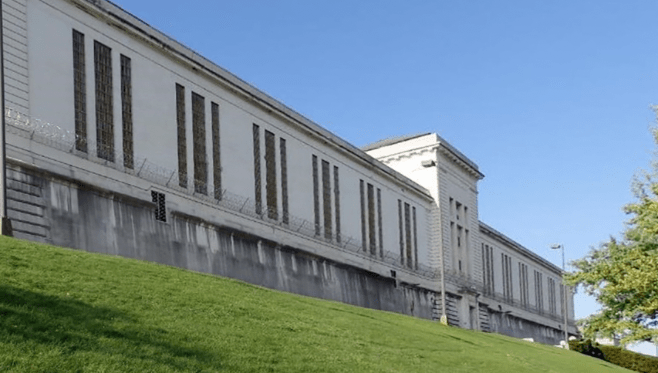
Even though State College wasn’t in our backyard, we’d still go over the mountains to State College to do things. Depending on how we’d go, we’d pass by a gargantuan megalith of a building, on College Avenue, just down from the mall. When I was a small kid, I imaged it was the home of very rich folks—striking grey walls that soared upward, an imposing and stately central vestibule, gently sloping front grounds with a curved driveway to the entryway, complete with wrought iron fences and gates and gatehouses at both ends of the driveway. It reminded me of something like the White House—only bigger and built out of grey stone.
But it wasn’t a residence—at least not in the typical sense of the word. The building does house people. It houses inmates. The building we’d often drive past on the way to go out to eat or to go shopping was none other than the Rockview State Correctional Institution, originally built in 1912 to take the place from Eastern State Penitentiary in Philadelphia, where the notorious Al Capone was famously incarcerated, and Western Penitentiary in Pittsburgh. As it is, Rockview never ended up becoming the replacement for either of those facilities.
Today Rickview is a medium-security prison for men, who primarily occupy themselves with taking care of the fields and gardens on Rockview’s expansive 4269 acres. Rockview is the home of Pennsylvania’s execution chamber, though. It’s not the home of PA’s “death row,” however. Prisoners sentenced to execution are transported to Rockview from death rows in maximum security prisons across the state a few days before their scheduled execution. The last execution at Rockview was in July 1999. Rockview is also the headquarters for the Centre County Pennsylvania State Police. And my brother-in-law is a security guard there!
So not only is State College, Pennsylvania an important hub of entertainment, transportation, education, and health and human services, it’s also an important hub for governmental activity, particularly for law enforcement, what with Rockview Penitentiary and the State Police being there as well.
You might be wondering why all this talk about prison. It’s not especially uplifting talk. Well, today’s gospel is one that includes some bombshell legal material, even criminal. Jesus is in the region of Cæsarea Phillipi, a city founded by Herod’s son, Philip II, to be his administrative capital in the provinces Palestine and Syria. The name of the city gives honor to its founder and king—Philipi, Philip. It also honors the emperor, Cæsarea, Cæsar. You might be tempted to think that’s to honor Julius Cæsar, but in fact it’s meant to honor Cæsar Augustus, the first true emperor of Rome. Either way, the name was given to make clear that this was a Roman city, and who was in charge—the emperor and the king.
Submission to the emperor as the supreme ruler of the empire cannot be overstated; as Americans, we struggle to really understand the level of loyalty that the empire demanded of its citizens and anyone who lived within its jurisdiction. Cæsar Augustus not only considered himself the emperor, but he also believed himself to be a god on earth himself—akin to the Egyptian understanding of the pharaoh. The emperor demanded treatment like a god on earth. The Latin expression, “Ave, Cæsar”—“Hail, Cæsar”—wasn’t merely a statement of support or admiration for the emperor. It was an exclamation of allegiance, felty, and obedience to the emperor as supreme ruler and god among people.
And so when Jesus is with his disciples in today’s gospel, he’s in a place where this political dynamic is brought to the forefront, simply by the name of the place. But what’s more, this Cæsarea Phillipi, as the administrative capital of Syria and Palestine, is also an important hub for commerce, travel, and entertainment. The business of the empire happened here, and it was on display everywhere. And this is the place that Jesus asks his disciples, “Who do people say that the Son of Man,” that is, he himself, “is?” They answer: “Some say John the Baptist, but others Elijah, and still others Jeremiah or one of the prophets.” Jesus then presses him, “But who do you say that I am?” And here’s where things get legal…where they get criminal…
Peter, always the one to open his mouth first, answers Jesus, “You are the Messiah, the Son of the living God.” Now—this is a confession, no doubt, about who Jesus is. Jesus is the Messiah, the anointed one of God, and Jesus is the Son of the living God. That is a true statement, and it’s a bold confession from Peter. But it’s even more than that when we consider where Peter makes this confesion, and what he confesses.
To declare that Jesus is the Messiah, the Son of the living God runs afoul of the expectation of those living under Roman rule. Cæsar is the supreme one. Cæsar is god among people. Not anyone else—and definitely not some rabbi tooling around Galilee. What Peter does here is commits treason against the emperor, and in Rome, the penalty for treason was execution—execution on a cross. Yet here we have Peter making this countercultural confession that could literally cost him his life. He tells Jesus, “you are the Messiah, the Son of the living God,” and we can just silently hear the unspoken followup, “not Cæsar Augustus.”
Jesus responds by telling Peter that he didn’t arrive at this confession on his own, but rather that God himself revealed it to him. This is none other than the working Holy Spirit who, like Jesus, does the will of God the Father in heaven. This confession that Jesus is the true supreme ruler and God among people is the cornerstone of any relationship with God, but it’s something that we don’t come to on our own, nor are we willing to admit on our own. Flesh and blood don’t reveal this to us, but God does.
In an interesting play on words, Jesus points to Peter’s name, πετρος, in Greek, which means “rock,” and tells him that what Peter just confessed is the rock upon which the church is built—the solid foundation of life as one charged as a Christian.
This way of looking at things, as Jesus as the supreme ruler and God among people, is the way that Christians, the way that we should view our lives. It’s our rock-view, if you will. We view things from the perspective of standing upon the rock of Christ, on the solid foundation that in, with, and through Jesus, God has all things under his power, and Jesus is himself God among people, God with us…Jesus is our rock-view. And we like Peter are called by the Holy Spirit to confess our allegiance, felty, and obedience to Jesus as has been revealed to us by the God the Father—even if costs us dearly in the eyes of the world.
“I, therefore,” writes St. Paul to the Ephesians, “the prisoner in the Lord, beg you to lead a life worthy of the calling to which you have been called.” Paul writes this while he’s imprisoned for his missionary work among the Greeks and Romans throughout the Mediterranean. Unlike Peter at Cæsarea Philipi, though, Paul did end up jailed and ultimately executed for his rock-view, his confession that Jesus is the supreme ruler and God among people. But even in the midst of his imprisonment, as “the prisoner in the Lord,” Paul encourages the faithful, he encourages us, to lead lives worthy of the calling to which we have been called. In other words, he’s calling us to do more than simply say we’re Christian, but to live lives like being Christian matters, to live lives like Jesus is the most important thing in our lives and not something else—to conform our lives to the example of Jesus.
If you were to be put on trial for being Christian, would there be enough evidence to convict you? Are you guilty of a life that puts Jesus and his ways before everything else? Do you have a rock-view of life? Do you lead a life worthy of calling yourself Christian? Do your words of confession match with deeds that could lead to a conviction for being a follower of Jesus? What would the verdict be?
Such a line of interrogation acquits each and every one of us…
We’d be innocent if accused and put on trial for living a godly life if it were up to us alone to lead lives worthy of the calling of Christian.
Each and every one of us fails at putting Jesus front and center, and we fail to see the face of God in the people around us, God among people. And yet it’s not what we say that matters; it’s not what we do that matters. It’s what God says. It’s what God does. And God tell us that our faith isn’t built upon what we say or what we do, but on Jesus, the very rock from which all life was hewn, from which you yourself were hewn, and the quarry from which you were dug. Our conviction is sure when we have this rock-view of life. The verdict is in already—we’re, each and every one of us, prisoners in the Lord, charged with taking care of the fields and gardens of God’s expansive creation, where Jesus is the supreme ruler and God among people, God with us…
This way of looking at things might seem suspect to the world, but to us who have been called, it’s beyond a reasonable doubt. It’s our charge and conviction. It’s our rock-view.
In the name of the Father and of the Son and of the Holy Spirit. Amen.
 The Rev'd Daniel W. Spigelmyer, Jr.